OpenClaw vs Hermes Agent: Use Cases and Risks
What Is OpenClaw?
OpenClaw is an open-source AI agent gateway. It lets people interact with an AI assistant through messaging channels and connected tools instead of using only a single chat window.
The best way to understand OpenClaw is this: it gives an AI agent a place to live. A user can message the agent, the agent can use skills and tools, and the setup can connect to different AI models and services.
OpenClaw is useful when the main problem is access. If a team wants an assistant that can work through familiar channels, coordinate tools, and respond to requests from chat, OpenClaw is the more natural starting point.
OpenClaw is strongest when:
- The workflow starts in chat.
- Multiple messaging channels matter.
- A team wants a self-hosted assistant gateway.
- The company wants to test an AI assistant before building custom automation.
- The value comes from quick access to an agent, not deep long-term learning.
What Is Hermes Agent?
Hermes Agent is an open-source AI agent from Nous Research. It can use tools, remember useful context, create skills, and keep improving how it completes repeated work.
The best way to understand Hermes Agent is this: it is built to learn from work. If the agent solves a hard problem, fixes an error, or discovers a repeatable process, it can save that process as a reusable skill.
Hermes Agent is useful when the main problem is repeatability. If a business has a recurring workflow that should get better over time, Hermes Agent is the more interesting starting point.
Hermes Agent is strongest when:
- The agent needs memory across sessions.
- The workflow repeats weekly, daily, or many times per month.
- The agent should save successful work patterns as skills.
- The company wants an automation backend, not only a chat assistant.
- A technical operator can review memory, skills, tools, and permissions.
Background: Why People Are Comparing Them
OpenClaw became popular because it made the idea of a self-hosted personal AI agent feel practical. It showed that an agent could run continuously, connect to communication channels, use tools, and complete tasks outside a normal chatbot.
Hermes Agent is now being compared to OpenClaw because it overlaps with many of those capabilities while putting more emphasis on memory and self-improvement. On May 22, 2026, OpenRouter's App & Agent Rankings listed Hermes Agent ahead of OpenClaw in the daily agent ranking, with Hermes Agent at 430B tokens and OpenClaw at 165B tokens for the Today view. OpenRouter also listed Hermes Agent as the fastest-growing app or agent for the week.
That ranking does not prove Hermes Agent is cheaper, safer, or better. It does show that people are actively testing it. The important shift is that AI agents are moving from one-off assistants toward systems that remember, adapt, and reuse successful workflows.
OpenClaw vs Hermes Agent: Quick Summary
OpenClaw is better when you want an AI assistant that is easy to reach from messaging channels.
Hermes Agent is better when you want an AI agent that can learn a repeated workflow and improve how it performs the task over time.
For business use, the best choice depends less on the product name and more on the workflow:
- If the work starts with people sending messages, start with OpenClaw.
- If the work repeats and should improve over time, start with Hermes Agent.
- If the workflow touches customer data, money, files, email, or production systems, start in a sandbox with human approval.
OpenClaw vs Hermes Agent At A Glance
| Question | OpenClaw | Hermes Agent |
|---|---|---|
| Short description | AI assistant gateway across channels | AI agent that learns workflows |
| Main strength | Messaging reach and gateway setup | Memory and self-improving skills |
| Best first use case | Chat-based assistant workflow | Repeatable operational task |
| Why people watch it | It became a popular open-source agent platform | It can create and refine skills |
| Main business risk | Too many users or channels controlling powerful tools | Too much memory or tool access without review |
| Best buyer question | Where should people interact with this agent? | What should this agent learn over time? |
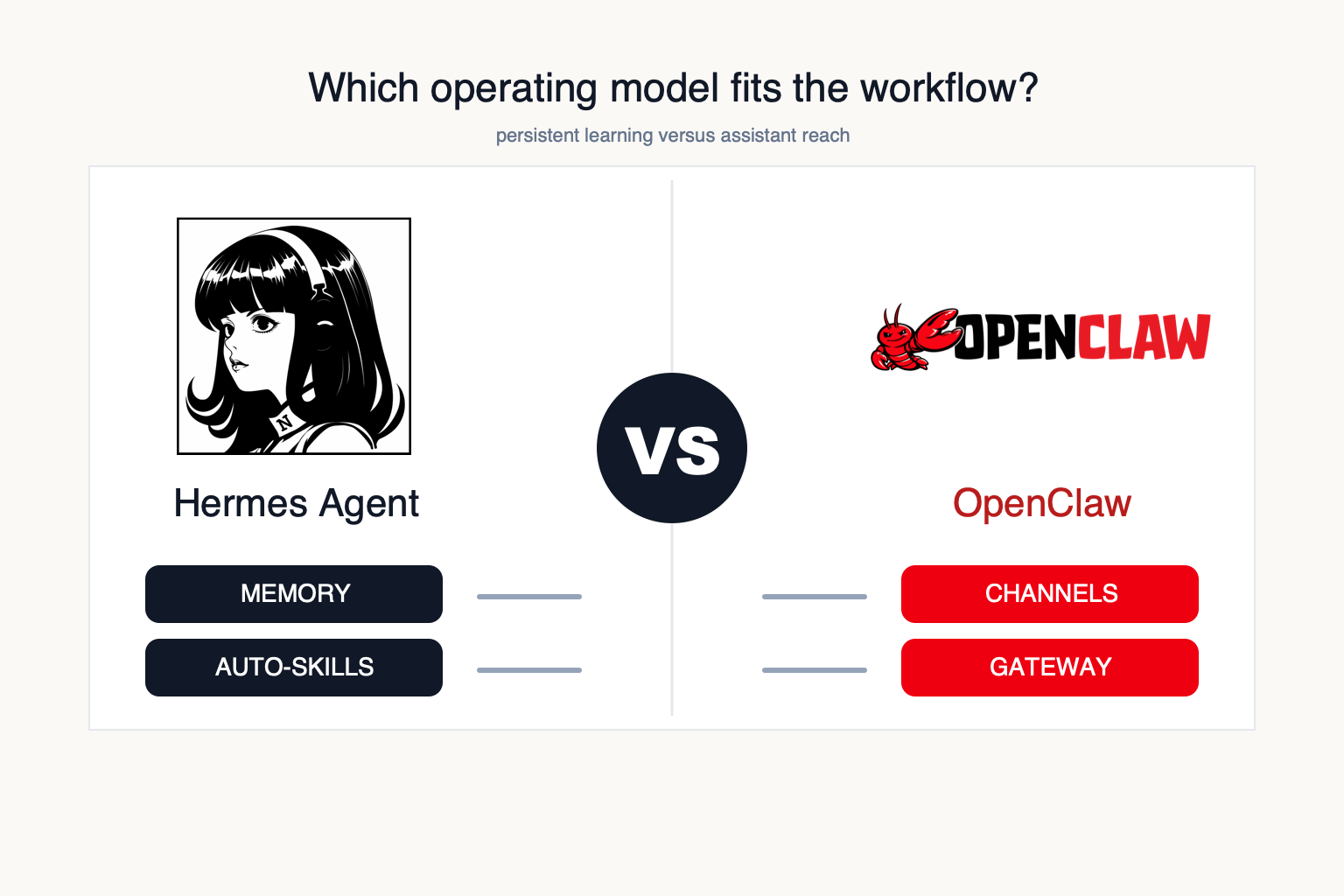
The Core Difference: Reach vs Learning
OpenClaw is about reach. It helps an AI agent show up where users already communicate.
Hermes Agent is about learning. It helps an AI agent remember what worked and reuse that knowledge later.
Both ideas are valuable, but they solve different business problems.
| Business situation | Better starting point | Reason |
|---|---|---|
| You want an assistant in messaging apps | OpenClaw | Channel access is the main value |
| You want an agent to remember how your company works | Hermes Agent | Memory and skills are central |
| You need recurring tasks to improve over time | Hermes Agent | Self-improvement is the stronger angle |
| You want to experiment with a chat-first assistant | OpenClaw | Easier workflow for many teams to test |
| You already use OpenClaw and want to test migration | Hermes Agent | Hermes has migration guidance for OpenClaw users |
| You are worried about security | Either, only in a sandbox | Both need strict permissions and approval rules |
How These AI Agents Work
An AI agent is different from a normal chatbot. A chatbot mainly replies to messages. An agent can decide what information it needs, call tools, use saved instructions, remember context, and repeat steps until it finishes a task.
The basic loop looks like this:
- You give the agent a goal.
- The agent checks its instructions, tools, memory, skills, and conversation history.
- It asks an AI model what to do next.
- It may answer you, call a tool, use a skill, search memory, or take another step.
- It repeats the process until it reaches a final answer or hits a limit.
This is powerful, but it is also why businesses need controls. An agent with access to the wrong tools can make mistakes faster than a human assistant.
Where OpenClaw Fits Best
OpenClaw fits best when the company wants to test an AI assistant as a communication layer.
Examples:
- An executive wants to message an assistant from a phone.
- A team wants to ask for basic operational help from chat.
- A company wants to test agent workflows before committing to deeper automation.
- The value comes from availability and channel access.
OpenClaw becomes risky when many people can steer one powerful agent. If it can access inboxes, files, customer records, payment tools, or internal systems, every channel becomes a possible control surface.
Where Hermes Agent Fits Best
Hermes Agent fits best when the company wants to improve a recurring workflow.
Examples:
- Weekly reporting.
- Support ticket summarization.
- Internal knowledge retrieval.
- CRM cleanup with review.
- Standard operating procedure drafts.
- Repeated research and analysis workflows.
Hermes Agent becomes risky when memory and skills are not reviewed. If the agent saves the wrong lesson, stores sensitive information, or creates low-quality skills, it can repeat mistakes at scale.
Why Hermes Agent Is Getting Attention
Hermes Agent is getting attention because it highlights a shift from one-time AI assistants to agents that accumulate experience.
The most important Hermes Agent features are:
- Skills: saved instructions for how to complete a task.
- Automatic skill creation: the agent can save a successful process for later.
- Curator: a background system that helps clean up old or low-value skills.
- Memory: stored information about preferences, workflow lessons, and useful context.
- Goal tracking: the agent can keep checking whether the goal was actually completed.
- Model flexibility: it can work with different AI model providers.
This matters because businesses do not just need AI answers. They need repeatable operating procedures. If an agent can learn those procedures safely, it becomes more useful than a chatbot.
Cost And Token Usage
OpenRouter's ranking is useful because it shows visible usage. It does not tell the full cost story.
More token usage can mean:
- More people are using the agent.
- The agent is handling more complex workflows.
- The agent is less token-efficient.
- The model or setup is doing extra reasoning before completing tasks.
For a business, the right question is not "which agent uses more tokens?" The right question is "how many dollars does it cost to complete one useful workflow with acceptable quality?"
Track cost per completed task, not only token volume.
Security And Business Risk
The biggest mistake is treating OpenClaw or Hermes Agent like a normal app. They are not normal apps. They can combine model output, memory, tools, files, credentials, messaging, browser access, and sometimes shell access.
That means the business risk is not only bad answers. The risk is bad actions.
| Risk | What it means | Safer setup |
|---|---|---|
| Messaging access | The wrong person can tell the agent what to do | User allowlists and private channels |
| Memory | The agent may save sensitive information | Review memory and avoid storing secrets |
| Tool access | The agent can act in real systems | Start with read-only or test tools |
| API keys | Keys can spend money or access data | Use scoped keys and rotate them |
| Files and code | The agent can change important assets | Use sandbox folders and approvals |
| Browser or inbox access | The agent can behave like a logged-in user | Use dedicated accounts with limited permissions |
Which One Should You Choose?
Choose OpenClaw if the main goal is an AI assistant that can be reached through messaging channels and act as a gateway between people, tools, and AI models.
Choose Hermes Agent if the main goal is an AI agent that can learn repeatable workflows, remember useful context, and turn successful work into reusable skills.
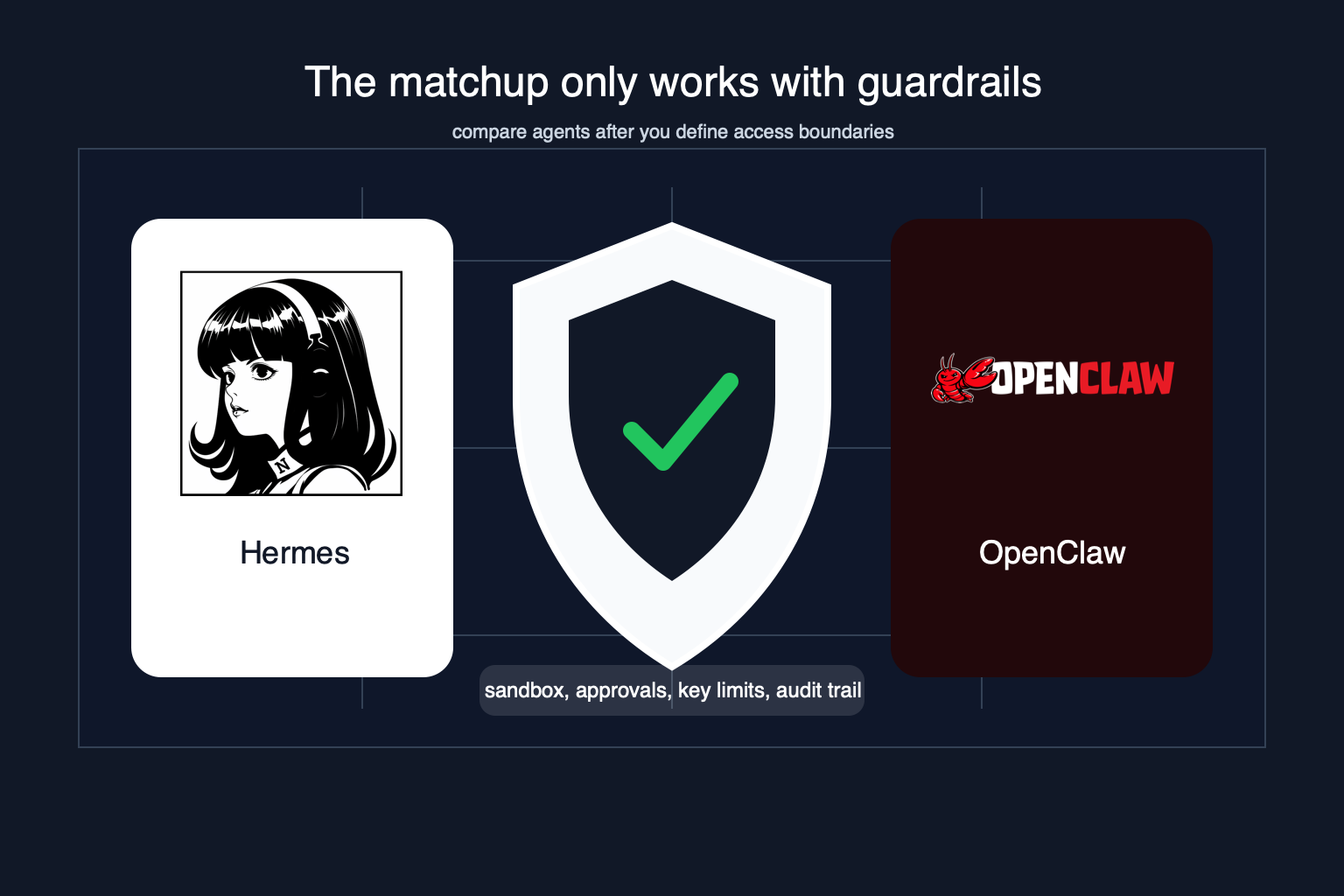
Choose neither for production until you have a narrow use case, a sandbox, approval rules, and a clear owner for the workflow.
Best First Use Cases For A Business
Start with work that is repetitive, valuable, and not too risky.
Good first tests include:
- Summarizing support tickets.
- Preparing weekly sales follow-up lists.
- Drafting internal reports from approved data.
- Organizing meeting notes into next steps.
- Cleaning CRM records in a review-only workflow.
- Building first drafts of standard operating procedures.
- Answering internal questions from approved documents.
Avoid starting with:
- Payments.
- Legal decisions.
- Medical decisions.
- Production code changes.
- Customer refunds.
- Sending emails without approval.
- Anything that touches sensitive data without review.
Simple Implementation Plan
Phase 1: Map The Workflow
Pick one workflow and write down how a human does it today. Do not start with the tool. Start with the business process.
Phase 2: Run A Sandbox Test
Give the agent test data, limited tools, and no production credentials. Measure whether it can complete the workflow correctly.
Phase 3: Add Human Approval
Let the agent prepare work, but require a person to approve anything that changes a system, sends a message, or touches customer data.
Phase 4: Measure Value
Track time saved, error rate, cost per completed task, and how often a human has to intervene.
Phase 5: Expand Carefully
Only add more tools, data, or users after the first workflow is stable.
Frequently Asked Questions
What is OpenClaw?
OpenClaw is an open-source AI agent gateway that connects an assistant to messaging channels, tools, models, and skills so users can ask it to complete tasks from familiar chat apps.
What is Hermes Agent?
Hermes Agent is an open-source AI agent from Nous Research that can remember user preferences, use tools, create reusable skills, and keep working on tasks across sessions.
Is Hermes Agent better than OpenClaw?
Hermes Agent is better for self-improving workflows, persistent memory, and reusable skills. OpenClaw is better when the priority is broad messaging access and a gateway-style assistant. The right choice depends on the workflow.
Why are people comparing Hermes Agent and OpenClaw now?
People are comparing them because Hermes Agent has gained visible usage momentum on OpenRouter rankings and because its automatic skill creation highlights self-improvement as a major agent capability.
Which one is safer for a business?
Neither is automatically safe. The safer option is the one deployed with limited accounts, approval steps, restricted tools, scoped API keys, logs, and a rollback plan.
Do non-technical teams need a developer to use OpenClaw or Hermes Agent?
A business should involve a technical operator before connecting either agent to email, files, CRM data, payments, code, or customer systems.
Can OpenClaw or Hermes Agent replace employees?
No. They are better understood as automation helpers for specific tasks. They can reduce repetitive work, but they still need workflow design, supervision, and business accountability.
Which AI agent should a small business test first?
Test OpenClaw first if the main need is a chat-based assistant across messaging apps. Test Hermes Agent first if the main need is a recurring workflow that should improve and remember how the business works.
Fixed Labs View
The right first move is not simply "install OpenClaw" or "install Hermes Agent." The right first move is to choose one workflow where an AI agent can safely save time or reduce operational drag.
Fixed Labs can help map that workflow, score the data risk, choose the right agent architecture, and build a controlled pilot before the agent touches sensitive systems.