Lovable vs Replit: Best AI App Builder for Business?
Start With What You Are Building
Most people comparing Lovable and Replit ask which tool is better overall. That question is too broad.
The useful question is narrower:
Which tool ships **this specific project** faster, with acceptable quality, at a cost that makes sense for this stage?
A SaaS landing page has a different best answer than a Python API. A solo founder prototype has a different best answer than a team-shipped product. A React dashboard has a different best answer than a multi-language microservice.
This guide covers:
- What Lovable and Replit actually do.
- How their workflows differ in practice.
- When Lovable is the faster path.
- When Replit is the faster path.
- How pricing compares at each stage.
- What to test before committing to either tool.
What Lovable And Replit Actually Do
Both tools generate working applications from natural language prompts. The difference is what kind of application they generate, who they are designed for, and where that application lives.
Lovable is an AI app builder focused on generating full-stack React and Next.js web applications. It integrates natively with Supabase for databases, authentication, and storage. You describe what you want in plain English, Lovable generates the code with polished UI using shadcn/ui and Tailwind CSS, and you can deploy to a custom domain in one click. Lovable also offers a visual editor for fine-tuning without writing code.
As of May 2026, Lovable positions itself as the fastest way to go from idea to deployed web app, particularly for SaaS products, internal tools, and landing pages.
Replit is a cloud-based development platform with a deeply integrated AI agent. It supports dozens of programming languages and frameworks. You can build full-stack applications entirely in the browser, with built-in hosting, databases, and deployment. Replit Agent can scaffold projects, write code, debug errors, install dependencies, and deploy applications autonomously.
Replit serves a broader audience: developers, students, educators, and teams who want a complete cloud IDE with AI assistance.
| Feature | Lovable | Replit |
|---|---|---|
| Primary focus | React/Next.js web apps | Multi-language full-stack development |
| Framework support | React, Next.js, Tailwind, shadcn/ui | Python, Node.js, Go, Vue, Svelte, React, and more |
| Backend integration | Supabase (native) | Built-in PostgreSQL, SQLite, key-value stores |
| Deployment | One-click to Lovable hosting or Netlify | Built-in hosting with autoscale deployments |
| Visual editor | Yes, alongside AI generation | Live preview, but primarily code-focused |
| AI model | Proprietary (Plan Mode + Agent Mode) | Replit Agent with multiple model support |
| Collaboration | Team workspaces on paid plans | Real-time multiplayer editing |
| Code export | GitHub sync | GitHub import/export, full filesystem access |
| Custom domains | Yes, on paid plans | Yes, on paid plans |
| Mobile access | Web-based | iOS and Android apps available |
The Audience Question Matters More Than Feature Lists
The single biggest differentiator between Lovable and Replit is who they are built for.
Lovable is designed for people who want to ship a web app without deep coding knowledge. The interface hides most of the code. You describe features in plain language, review the generated UI visually, and iterate. When you need backend functionality, Supabase integration is built in. The entire workflow is optimized for getting a React web app from zero to deployed as fast as possible.
Replit is designed for people who want a complete development environment in the browser. It is a real IDE with a terminal, package manager, debugger, and file system. The AI agent assists you, but you have full control over the code. This makes Replit more powerful for complex projects, but it also means a steeper learning curve for non-developers.
| User profile | Better first choice | Why |
|---|---|---|
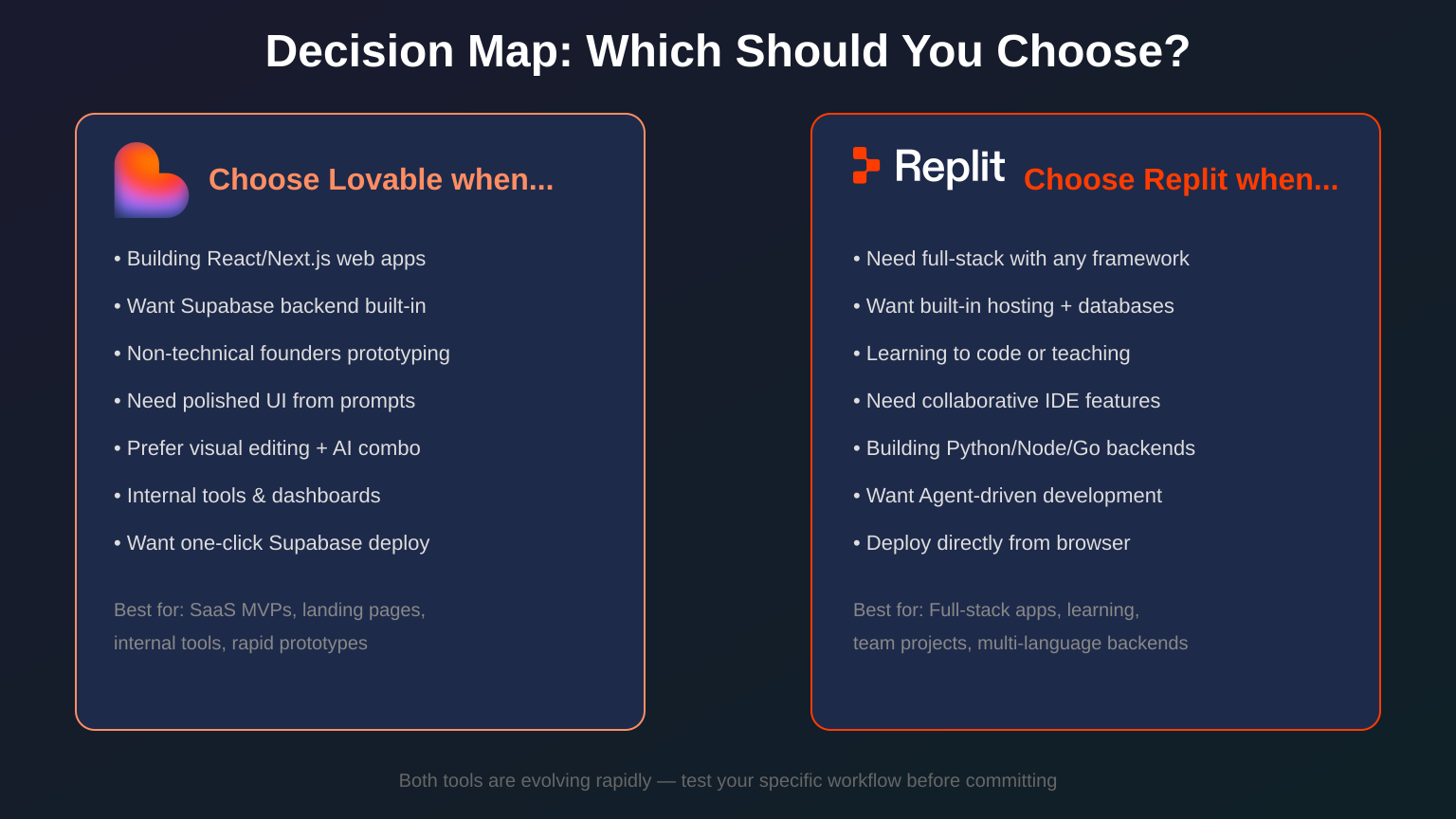
| Non-technical founder building MVP | Lovable | Lower barrier, visual editing, instant deploy |
| Developer wanting AI-assisted coding | Replit | Full IDE, terminal access, any language |
| Student learning to code | Replit | Educational features, community, structured learning |
| Product team prototyping UI | Lovable | Faster visual iteration, polished component library |
| Team building a Python/Go backend | Replit | Lovable does not support non-JS backends |
| Startup needing quick landing page | Lovable | Templates and design-first workflow |
| Developer wanting cloud IDE without setup | Replit | Zero-config environment with full tooling |
| Team collaborating on code in real time | Replit | Multiplayer editing is a core feature |
If you know you are building a React web app and want the fastest path from idea to URL, Lovable removes friction. If you need flexibility across languages, frameworks, or infrastructure, Replit gives you room to grow.
Pricing: Where The Real Cost Difference Lives
Pricing is where most comparisons get lazy. They list plan prices side by side and stop there. The real question is what you get at each tier and how that maps to actual usage.
| Tier | Lovable | Replit |
|---|---|---|
| Free | $0/mo (5 credits/day, 30/month) | $0/mo (limited AI and compute) |
| Entry paid | ~$25/mo (Starter, more credits) | $7/mo (Hacker, basic AI access) |
| Mid-tier | ~$39/mo (Pro, higher credit allowance) | $25/mo (Pro, unlimited AI with effort-based usage) |
| Teams | Custom pricing | $40/user/mo (Teams, admin controls) |
| Enterprise | Custom | Custom |
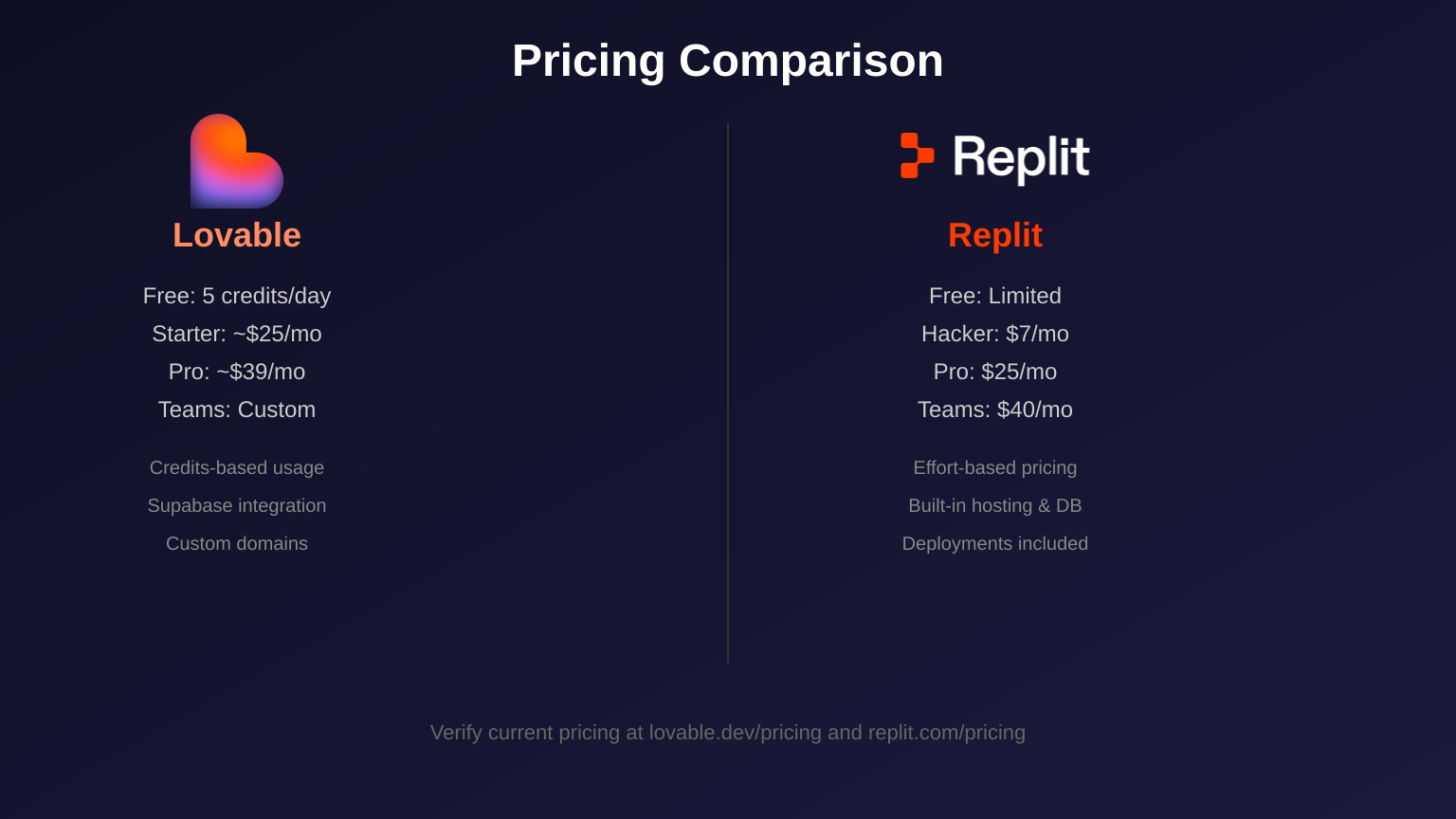
Free tier comparison: Lovable gives 5 credits per day with a 30-credit monthly cap. This is enough to test the platform and build small prototypes. Replit's free tier provides limited AI access and compute, suitable for exploration but not sustained building.
Solo developer comparison: Replit Hacker at $7/mo is significantly cheaper than Lovable Starter at approximately $25/mo. However, Lovable Starter includes Supabase integration, custom domains, and a visual editor that Replit Hacker does not emphasize. Replit Pro at $25/mo matches Lovable Starter's price but offers unlimited AI interactions with effort-based consumption.
Team comparison: Replit Teams at $40/user/mo adds centralized billing, admin controls, and team collaboration. Lovable's team pricing is custom and should be verified directly. For teams already committed to the React/Supabase stack, Lovable may offer better integrated value. For teams working across multiple languages or needing full IDE features, Replit Teams delivers broader capability.
The hidden cost: Credit and effort consumption varies enormously by project complexity. In Lovable, a simple footer removal costs about 0.90 credits, while building a full landing page with images can cost several credits. In Replit, effort-based pricing means complex agent workflows consume more resources. Track your actual usage during free trials before committing.
Workflow Speed: Where Each Tool Wins
Shipping speed depends on the project type and your familiarity with the target stack.
When Lovable Ships Faster
Lovable is faster when:
- You are building a React/Next.js web app. The generated code follows established patterns with shadcn/ui components and requires minimal cleanup.
- You want polished UI immediately. The component library produces professional-looking interfaces out of the box.
- You need Supabase backend. Authentication, database, and storage are pre-integrated. No separate account setup or configuration needed.
- You are a non-technical founder. The visual editor and prompt-based workflow minimize code exposure.
- You want one-click deployment. Push to a live URL without configuring hosting, DNS, or build pipelines.
When Replit Ships Faster
Replit is faster when:
- You need a non-React backend. Python, Go, Rust, and other languages are supported natively.
- You want a full development environment. Terminal, package manager, debugger, and file system are all available.
- You are iterating on complex logic. Direct code access and debugging tools make it easier to fix issues.
- You need built-in databases without Supabase. PostgreSQL, SQLite, and key-value stores are provisioned instantly.
- You are deploying a production service. Autoscale deployments handle traffic spikes without external infrastructure.
- You are collaborating with a team. Multiplayer editing lets multiple people code simultaneously.
The Practical Test
Before choosing, run this test:
- Pick a representative feature from your project.
- Prompt both tools with the same description.
- Measure time to working prototype.
- Assess code quality: can you maintain this code for six months?
- Check deployment: how many steps from generated code to live URL?
The tool that wins this test for your specific project is the right choice. General comparisons cannot answer this.
Code Quality And Maintainability
Generated code is only useful if someone can maintain it later.
Lovable produces consistent React code because it is constrained to one framework and one component library. The output typically uses Next.js App Router conventions, Tailwind CSS for styling, and shadcn/ui for components. This consistency makes it easier for a React developer to pick up later. Lovable also supports GitHub sync, so you can export and maintain the code independently.
Replit produces code in whatever language and framework you choose. Quality depends on the specificity of your prompts and the complexity of the project. Because Replit gives you full code access and a real IDE, you can refactor, test, and debug generated code more thoroughly. The tradeoff is that you need more technical skill to maintain it.
For both tools, prompt specificity matters enormously. A vague prompt like "build me a dashboard" produces generic output. A specific prompt like "build a Next.js 14 dashboard with sidebar navigation, a data table using TanStack Table, and a profit chart using Recharts" produces much better code.
| Code quality factor | Lovable | Replit |
|---|---|---|
| Consistency | High (single framework) | Variable (multi-framework) |
| Component patterns | shadcn/ui standard | Depends on framework and prompt |
| File structure | Predictable Next.js | Varies by project type |
| Production readiness | Higher for React web apps | Depends on developer oversight |
| Debugging capability | Limited (visual editor) | Full IDE with terminal and debugger |
| Customization ceiling | High within React/Next.js | High across all supported languages |
Deployment And Hosting
Deployment is where the tools diverge most sharply.
Lovable deploys to its own hosting platform or Netlify with one click. Custom domains are supported on paid plans. The deployment pipeline is optimized for React/Next.js applications. If you need to host elsewhere, you can export via GitHub sync and configure your own deployment.
Replit includes built-in hosting with autoscale deployments. You can deploy any web application directly from the IDE without external services. Replit supports custom domains, always-on deployments, and automatic scaling. For production applications, this eliminates significant DevOps overhead.
| Deployment factor | Lovable | Replit |
|---|---|---|
| One-click deploy | Yes (Lovable hosting or Netlify) | Yes (built-in hosting) |
| Custom domain | Yes, paid plans | Yes, paid plans |
| Database | Supabase (integrated) | Built-in PostgreSQL, SQLite, KV |
| Export options | GitHub sync | GitHub, ZIP, full filesystem |
| Self-hosting | Export and configure | Export and configure |
| Autoscale | Via hosting platform | Built-in autoscale deployments |
| Preview deployments | Yes | Yes |
When To Use Neither
AI app builders are powerful for prototyping and accelerating development. They are not replacements for engineering judgment.
Avoid relying solely on AI-generated code when:
- The application handles payments, personal health data, or legal compliance.
- Security requirements demand audited, reviewed code.
- The project has complex business logic that requires domain expertise.
- Performance-critical paths need hand-optimized code.
- The team lacks the ability to review and maintain generated code.
In these cases, use AI builders for exploration and prototyping, then rebuild critical paths with human oversight.
Simple Decision Framework
| Your situation | Start with | Reason |
|---|---|---|
| React/Next.js web app, fast MVP | Lovable | Tightest integration, visual editing |
| Non-React framework or language | Replit | Lovable does not support non-JS stacks |
| Solo developer, budget-conscious | Replit | $7/mo Hacker plan is cheapest entry |
| Non-technical founder | Lovable | Lowest barrier to shipped product |
| Full-stack app with Python/Go backend | Replit | Native multi-language support |
| Internal tool with Supabase | Lovable | Pre-integrated backend |
| Learning to code | Replit | Educational features and community |
| Team collaboration on code | Replit | Multiplayer editing is core |
| Marketing site or landing page | Lovable | Design-first workflow |
| Production SaaS with scaling needs | Either, then engineer | Prototype fast, harden carefully |
Frequently Asked Questions
What is Lovable?
Lovable is an AI-powered app builder that generates full-stack React and Next.js applications from natural language prompts. It integrates with Supabase for backend functionality, supports visual editing, and deploys to custom domains.
What is Replit?
Replit is a cloud-based development platform with an integrated AI agent. It supports multiple programming languages, includes built-in hosting and databases, and offers collaborative IDE features for building and deploying applications.
Is Lovable or Replit better for non-technical founders?
Lovable is generally better for non-technical founders because it focuses on generating polished UI from prompts with minimal code exposure. Replit requires more comfort with a development environment.
Can I use Lovable and Replit for free?
Yes. Lovable offers 5 credits per day and 30 per month on the free tier. Replit offers limited free access to AI and compute. Both are sufficient for testing.
Which AI app builder is cheaper?
Replit Hacker at $7/mo is the cheapest entry point. Lovable Starter at approximately $25/mo includes more integrated features. Replit Pro at $25/mo offers unlimited AI with effort-based pricing. Compare your expected usage before choosing.
Does Lovable only work with React?
Lovable primarily generates React and Next.js applications. Replit supports Python, Node.js, Go, Vue, Svelte, and many other languages and frameworks.
Can I export code from Lovable and Replit?
Yes. Lovable supports GitHub sync. Replit provides full filesystem access and GitHub import/export. Both produce standard project files.
Which tool has better deployment options?
Replit offers more flexible deployment with built-in hosting, autoscale, and support for any framework. Lovable deploys to its own hosting or Netlify, optimized for React apps.
How do credits work in Lovable?
Credits are consumed based on task complexity. Simple edits cost under 1 credit. Complex builds cost several credits. Free users get 5 credits daily. Paid plans include higher allowances with rollover.
How does Replit effort-based pricing work?
Replit Pro measures AI resource consumption as effort rather than flat credits. Simple tasks use less effort, complex agent workflows use more. Additional effort can be purchased beyond the included amount.
Fixed Labs View
The right first move is not "install Lovable" or "install Replit." The right first move is to define what you are building, who will maintain it, and where it will be hosted.
Fixed Labs can help evaluate which AI app builder fits your project, estimate the real cost of generated code maintenance, and build a controlled pilot before committing to a tool or platform.