Supabase vs Firebase: Best Backend for AI-Powered Apps?
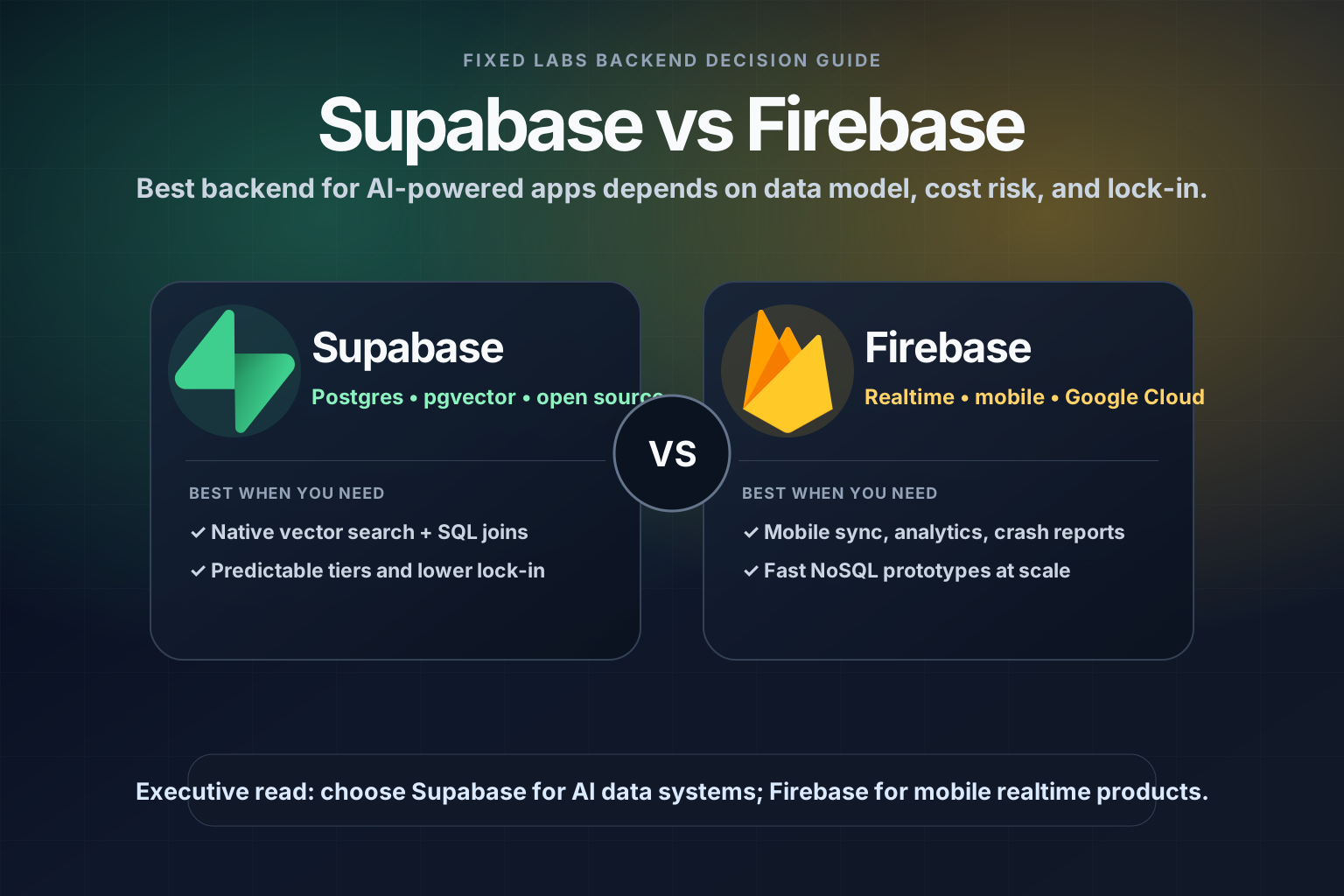
The Backend Choice Shapes Your AI Architecture
Choosing between Supabase and Firebase is not just a hosting decision. It determines your data model, your query capabilities, your cost trajectory, and whether you can run vector search without adding another service.
For businesses building AI-powered applications in 2026, this choice matters more than ever. Vector embeddings, semantic search, and RAG pipelines have moved from experimental to essential. The backend you pick either supports these natively or forces you to bolt them on.
This guide covers:
- What Supabase and Firebase actually provide.
- How their database models affect AI application design.
- Pricing comparison at each growth stage.
- Vector search and AI-native feature comparison.
- Self-hosting, vendor lock-in, and migration paths.
- A decision framework for business owners.
What Supabase And Firebase Actually Are
Supabase is an open-source backend-as-a-service built on PostgreSQL. It wraps the world's most advanced relational database with auto-generated APIs, authentication, real-time subscriptions, file storage, and edge functions. Crucially for AI applications, it includes pgvector for native vector storage and similarity search.
Supabase positions itself as "the Postgres developer platform." Everything runs on standard PostgreSQL, which means your data is portable, your queries are SQL, and your skills transfer across projects.
Firebase is Google's application development platform. Its core database is Cloud Firestore, a NoSQL document store optimized for real-time synchronization across mobile and web clients. Firebase also offers a Realtime Database, Cloud Functions, Hosting, Authentication, and deep integration with Google Cloud services including Gemini AI, Analytics, Crashlytics, and Cloud Messaging.
Firebase positions itself as a complete mobile and web development platform. Its strength is reducing time-to-market for applications that need real-time data sync, push notifications, and analytics out of the box.
| Feature | Supabase | Firebase |
|---|---|---|
| Database | PostgreSQL (relational) | Cloud Firestore (NoSQL document) |
| Vector search | Native pgvector | Requires Vertex AI or external |
| Query language | SQL | Custom query API |
| Real-time | PostgreSQL replication | Native real-time sync |
| Authentication | Email, OAuth, SSO, magic links | Email, OAuth, phone, anonymous |
| File storage | S3-compatible object storage | Cloud Storage for Firebase |
| Edge/serverless functions | Deno-based Edge Functions | Node.js Cloud Functions |
| Self-hosting | Yes (Docker, open-source) | No |
| AI integration | OpenAI, Hugging Face, LangChain | Gemini AI, Vertex AI |
| Mobile SDKs | Community-maintained | Official iOS, Android, Flutter |
| Analytics | Basic (via integrations) | Built-in Google Analytics |

The Database Model Decision Matters Most
The single most consequential difference between Supabase and Firebase is the database model. This is not a technical detail — it shapes how you build, query, and scale AI applications.
PostgreSQL (Supabase): Structured Data With Vector Superpowers
PostgreSQL is a relational database. Data lives in tables with defined schemas, connected by foreign keys, queried with SQL. For AI applications, this matters because:
- pgvector is native. You can store embeddings alongside your structured data in the same database. A single query can join user profiles, transaction history, and semantic similarity scores. No separate vector database needed.
- Complex queries are first-class. Need to find "all customers who purchased in the last 30 days AND have support tickets with sentiment below 0.3 AND are semantically similar to this product description"? That is one SQL query with pgvector. In Firestore, it would require multiple queries and client-side joining.
- Data integrity is enforced. Foreign keys, constraints, and transactions ensure your data stays consistent. For AI applications that make decisions based on stored data, this reliability matters.
- Mature ecosystem. Every BI tool, ETL pipeline, and analytics platform supports PostgreSQL. Your AI application integrates with your existing data infrastructure.
Cloud Firestore (Firebase): Flexible Documents With Real-Time Sync
Firestore is a NoSQL document database. Data lives in collections of JSON-like documents, queried with a custom API. For AI applications, this matters because:
- Schema flexibility. Documents do not require predefined schemas. This accelerates early-stage development when your AI application's data model is still evolving.
- Real-time is built-in. Firestore's real-time listeners are extremely low-latency. For collaborative AI interfaces, live dashboards, or chat applications, this is a significant advantage.
- Mobile-first design. Firestore's offline persistence and sync capabilities are best-in-class for mobile applications that need to function without constant connectivity.
- Google AI integration. Firebase connects directly to Gemini AI and Vertex AI for embedding generation, model serving, and AI-powered features without managing separate infrastructure.
| Use case | Better choice | Why |
|---|---|---|
| RAG pipeline with structured metadata | Supabase | pgvector + SQL joins in one query |
| Mobile app with offline sync | Firebase | Native offline persistence |
| Semantic search over documents | Supabase | Native vector indexing |
| Real-time collaborative editor | Firebase | Lower-latency real-time sync |
| Multi-tenant SaaS with complex permissions | Supabase | Row-level security + SQL |
| App with push notifications and analytics | Firebase | Built-in FCM and Analytics |
| AI chatbot with conversation history | Either | Both handle this well |
| Data warehouse integration | Supabase | Standard PostgreSQL connectors |
Pricing: Predictable vs Pay-As-You-Go
Pricing is where Supabase and Firebase diverge most sharply, and where the wrong choice creates budget surprises.
| Tier | Supabase | Firebase |
|---|---|---|
| Free | $0/mo (500 MB DB, 50K MAU, 5 GB egress) | $0/mo (1 GB Firestore, 10 GB egress, 50K reads/day) |
| Entry paid | $25/mo (Pro: 8 GB disk, 100K MAU, 250 GB egress) | Pay-as-you-go (Blaze: usage-based, $300 free credit) |
| Mid-tier | $599/mo (Team: SOC2, SSO, priority support) | Usage-based (scales with reads/writes/storage) |
| Enterprise | Custom (BYO cloud, SLAs, dedicated support) | Custom (volume discounts, dedicated support) |

Free tier comparison: Firebase offers more storage (1 GB vs 500 MB) but imposes daily read limits (50K reads/day). Supabase offers unlimited API requests but less storage. For prototyping AI applications, Supabase's unlimited API requests matter more than raw storage size.
Growth stage comparison: This is where the models diverge. Supabase Pro at $25/mo includes 8 GB disk, 100K monthly active users, and 250 GB egress. Costs are predictable. Firebase Blaze charges per read ($0.06/100K), per write ($0.18/100K), and per GB stored ($0.18/GB/month). An AI application that performs frequent vector similarity searches can generate millions of reads per day, making Firebase significantly more expensive than expected.
The hidden cost of Firestore reads: Every vector similarity search in Firestore (if using Vertex AI Vector Search) counts as reads. A RAG pipeline that retrieves context for every user message can easily hit 1M+ reads/day. At $0.06/100K reads, that is $18/day or $540/month — just for reads. Supabase includes unlimited queries in its Pro plan.
Team and compliance: Supabase Team at $599/mo includes SOC2, ISO 27001, SSO, and HIPAA as a paid add-on. Firebase requires Google Cloud's enterprise agreements for equivalent compliance certifications, which typically start at higher price points.
Vector Search And AI-Native Features
For businesses building AI applications in 2026, vector search capability is often the deciding factor.
Supabase: pgvector Built In
Supabase includes pgvector as a standard PostgreSQL extension. This means:
- Zero additional infrastructure. Vector storage and search live in the same database as your application data.
- SQL-native queries. Combine vector similarity with traditional filters, joins, and aggregations in a single query.
- Multiple index types. HNSW and IVFFlat indexes for different performance/cost tradeoffs.
- Automatic embeddings. Supabase provides Edge Functions for generating embeddings using OpenAI, Hugging Face, and other providers.
- Cost included. No per-query charges for vector search on Pro plan and above.
Firebase: Vertex AI Required
Firebase does not include native vector search. Options include:
- Vertex AI Vector Search. Google's managed vector database. Powerful but adds complexity, cost, and a separate service to manage.
- External vector databases. Pinecone, Weaviate, or Qdrant can integrate with Firebase but add operational overhead.
- Gemini AI integration. Firebase connects directly to Gemini for embedding generation and model serving, but vector storage still requires Vertex AI or an external service.
| AI feature | Supabase | Firebase |
|---|---|---|
| Native vector search | Yes (pgvector) | No (requires Vertex AI) |
| Embedding generation | Edge Functions + any provider | Gemini AI built-in |
| RAG pipeline support | Native SQL + pgvector | Requires Vertex AI setup |
| Semantic search | Single SQL query | Multiple service calls |
| Hybrid search (keyword + vector) | Native tsvector + pgvector | Requires separate configuration |
| AI provider flexibility | Any (OpenAI, HF, Anthropic, etc.) | Primarily Gemini/Vertex |
| Cost per vector query | Included in plan | Per-query Vertex AI pricing |
Self-Hosting And Vendor Lock-In
This is where Supabase and Firebase differ fundamentally.
Supabase is fully open-source. You can self-host using Docker on any infrastructure — AWS, GCP, Azure, bare metal, or your own data center. This means:
- Complete data ownership and sovereignty.
- No vendor lock-in. Migrate away at any time by exporting standard PostgreSQL dumps.
- Compliance flexibility for regulated industries.
- Cost control at extreme scale (no per-query markup).
Firebase is proprietary. There is no self-hosted option. Your data lives in Google Cloud, and migration requires rewriting your data access layer. The Firebase emulator suite helps with local development, but production always runs on Google's infrastructure.
For businesses in healthcare, finance, or government, self-hosting capability may be a hard requirement. Supabase satisfies this. Firebase does not.
Real-Time Features And Mobile Support
Firebase's original strength remains relevant. If your AI application needs:
- Low-latency real-time sync across thousands of concurrent clients.
- Offline-first mobile experiences with automatic conflict resolution.
- Push notifications through Firebase Cloud Messaging.
- Built-in analytics through Google Analytics for Firebase.
- Crash reporting through Crashlytics.
Firebase delivers these out of the box with minimal configuration. Supabase provides real-time subscriptions through PostgreSQL replication, but the latency is higher and mobile SDKs are community-maintained rather than official.
For pure web applications or server-rendered AI tools, Supabase's real-time is sufficient. For mobile-first products with heavy real-time requirements, Firebase retains an advantage.
Authentication Comparison
Both platforms offer comprehensive authentication, but with different strengths.
| Auth feature | Supabase | Firebase |
|---|---|---|
| Email/password | Yes | Yes |
| OAuth providers | Google, GitHub, Apple, Discord, etc. | Google, GitHub, Apple, Facebook, Twitter, Microsoft, Yahoo, etc. |
| Magic links | Yes | Yes |
| Phone/SMS auth | Yes (paid add-on) | Yes (free tier included) |
| Anonymous auth | Yes | Yes |
| SSO/SAML | Team plan ($599/mo) | Identity Platform (pay-per-use) |
| Multi-factor auth | Yes | Yes |
| User management API | Yes | Yes |
| Row-level security | Native PostgreSQL RLS | Security Rules (custom language) |
Firebase supports more OAuth providers out of the box and includes phone authentication in the free tier. Supabase's row-level security (RLS) is a significant advantage for multi-tenant AI applications — permissions are enforced at the database level, not the application level.
When To Use Neither
Both platforms are excellent for many use cases. Neither is right for everything.
Consider alternatives when:
- You need a dedicated vector database at massive scale. Pinecone, Weaviate, or Milvus may outperform pgvector beyond billions of vectors.
- Your application is purely serverless. Cloudflare Workers + D1 or PlanetScale may be simpler.
- You need graph database capabilities. Neo4j or Amazon Neptune serve relationship-heavy AI applications better.
- Compliance requires specific certifications not yet available. Check current certification status before committing.
Simple Decision Framework
| Your situation | Start with | Reason |
|---|---|---|
| AI app with RAG and structured data | Supabase | pgvector + SQL in one database |
| Mobile app with real-time sync | Firebase | Best-in-class mobile SDK and offline support |
| Need self-hosting or data sovereignty | Supabase | Fully open-source, Docker-deployable |
| Already using Google Cloud | Firebase | Seamless integration with existing services |
| Budget-sensitive at growth stage | Supabase | Predictable flat-rate pricing |
| Need built-in analytics and crash reporting | Firebase | Google Analytics and Crashlytics included |
| Multi-tenant SaaS with complex permissions | Supabase | Row-level security + PostgreSQL |
| Rapid prototype, unsure of data model | Firebase | Schema-flexible documents |
| Enterprise compliance (SOC2, HIPAA) | Supabase Team | Included at $599/mo |
| Heavy real-time collaboration | Firebase | Lower-latency sync engine |
Frequently Asked Questions
What is Supabase?
Supabase is an open-source backend-as-a-service built on PostgreSQL. It provides authentication, real-time subscriptions, file storage, edge functions, and native vector search through pgvector — all accessible through auto-generated REST and GraphQL APIs.
What is Firebase?
Firebase is Google's mobile and web application development platform. It offers Cloud Firestore (NoSQL), Realtime Database, Authentication, Cloud Functions, Hosting, and deep integration with Google Cloud services including Gemini AI, Analytics, and Crashlytics.
Is Supabase or Firebase better for AI applications?
Supabase is generally better for AI applications that require vector search, semantic similarity, and RAG pipelines because it includes pgvector natively in PostgreSQL at no extra cost. Firebase is better when you need tight integration with Google's Gemini AI models and mobile-first analytics.
Can I self-host Supabase?
Yes. Supabase is fully open-source and can be self-hosted using Docker. This gives you complete data ownership, no vendor lock-in, and the ability to run on your own infrastructure. Firebase does not offer a self-hosted option.
Is Firebase more expensive than Supabase?
It depends on usage patterns. Firebase uses pay-as-you-go pricing which can be cheaper for low-traffic apps but expensive at scale due to per-read/write costs. Supabase offers predictable flat-rate pricing starting at $25/mo for Pro, making costs easier to forecast for growing businesses.
Does Supabase support real-time features like Firebase?
Yes. Supabase provides real-time subscriptions through PostgreSQL's replication system. You can listen to INSERT, UPDATE, DELETE, and SELECT events on any table. Firebase's Realtime Database and Firestore offer similar functionality with lower latency for simple document sync.
Which platform has better authentication?
Both offer comprehensive authentication. Firebase Auth supports more social providers out of the box and includes phone authentication with SMS. Supabase Auth supports email, OAuth, magic links, and SSO (on Team plan). For enterprise SSO requirements, Supabase Team or Enterprise plans are competitive.
Can I migrate from Firebase to Supabase?
Yes, but it requires planning. The main challenge is migrating from Firestore's NoSQL document model to PostgreSQL's relational model. Supabase provides migration guides and tools. Many teams successfully migrate when they outgrow Firebase's pricing or need SQL capabilities.
Fixed Labs View
The right backend depends on what you are building, who will maintain it, and how your costs scale.
For AI-powered business applications in 2026, Supabase's combination of PostgreSQL, native vector search, and predictable pricing makes it the stronger default choice for most teams. Firebase remains excellent for mobile-first products that need real-time sync and Google ecosystem integration.
Fixed Labs can help evaluate which backend fits your AI application, estimate real infrastructure costs at your projected scale, and build a controlled pilot before committing to a platform.