CPA Billing Automation: Implementation Scope Ledger
Book a discovery call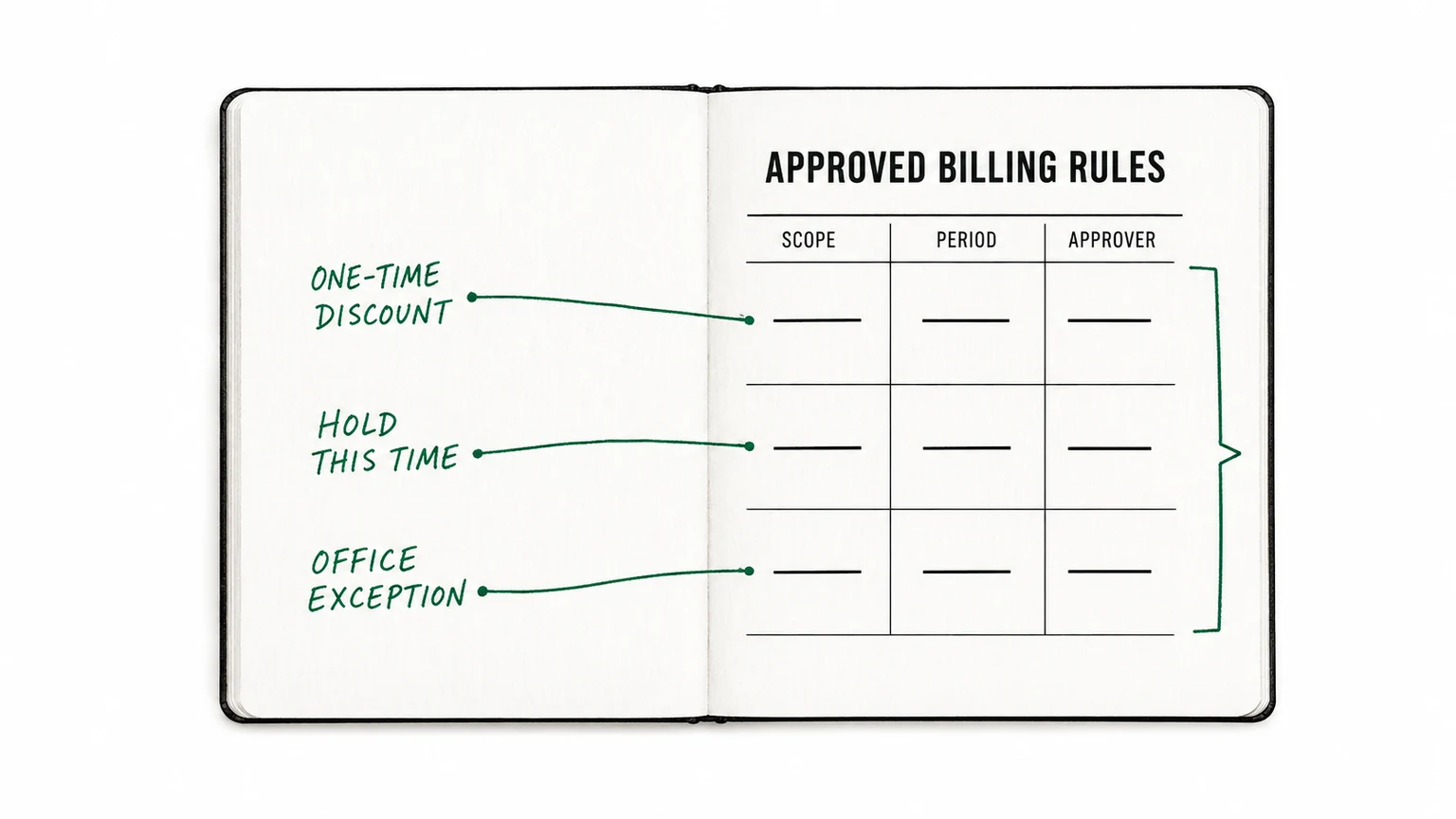
CPA billing automation implementation should be commissioned as a set of bounded deliverables, not as a promise that a connector will solve every billing problem. Start by testing what the current system already does, then assign the missing rules, integration work and historical-data decisions explicitly.
Book a discovery call to map one billing workflow, identify what native setup already covers and separate policy decisions from implementation work.
For one accounting-firm deployment, Fixed Labs spent two weeks working with the invoicing team, embedded in its Zoho Cliq channels and day-to-day team discussions. We gathered billing rules and exceptions, then turned that knowledge into documented instructions for a supervised workflow. That dated observation describes that firm’s preparation, not a standard timeline or a guarantee for another system.
Use a billing implementation scope ledger before work begins
The ledger below is a recommended planning tool, not a client delivery record or a software capability claim. It helps a CPA partner or billing manager commission one billing assignment with named work, owners, handovers and exclusions.

Download the ten-deliverable billing implementation scope ledger. It is a blank, editable planning artifact; it does not authorize billing actions or replace a firm’s professional judgment.
| Deliverable | Existing native capability | Missing business instruction | Implementation assignment | Firm owner | Implementer owner | Handover output | Exclusion |
|---|---|---|---|---|---|---|---|
| Source-system inventory | Existing systems can list their records | Which system is authoritative for client, time, agreement, draft and payment status | Name each source and its allowed use | Billing lead | Implementation lead | Authority map | Do not assume every system integrates |
| Native-feature fit check | Recurring and time-to-invoice features may already exist | Which live workflow proves the fit | Demonstrate one bounded configuration before custom work | Billing lead | Configuration lead | Fit-check record | Custom AI is not presumed necessary |
| Client and item mapping | Current IDs and service lists may exist | Which IDs are authoritative when records disagree | Map required fields and ownership | Client-data owner | Integration lead | Field map | Full master-data cleanup is separate |
| Billable-work definition | Time can be recorded or queued | Eligible, held, excluded and later-period treatment | Document selection rules and escalation | Billing policy owner | Workflow lead | Billable-work rule set | Implementation does not invent commercial policy |
| Agreement and exception capture | Agreements and notes may exist | Client, service, period and approval for an exception | Capture attributable rule and open questions | Engagement owner | Workflow lead | Exception register | A past concession is not automatic carry-forward |
| Draft-preparation boundary | A system may create drafts | Which preparation actions remain unsent | Specify draft steps and saved-draft check | Billing reviewer | Workflow lead | Draft procedure | Sending and collection are not implied |
| Office and template routing | Templates and offices may be configured | Supported combinations and exceptions | Record routing rules and unsupported cases | Operations owner | Configuration lead | Routing matrix | All offices or jurisdictions are not assumed supported |
| Integration-direction map | A connector may expose some actions | Read/write actions, trigger and direction for each flow | Map each source-to-destination action | Systems owner | Integration lead | Direction map | One connector does not imply two-way sync |
| Historical-data boundary | Historical WIP or AR may be exportable | Whether history belongs in this assignment | Decide WIP, opening AR, history and payment-token treatment | Finance owner | Migration lead | Written migration boundary | Historic imports and token migration are separate unless scoped |
| Team handover and maintenance | Existing procedures may be incomplete | Who owns policy changes and requests | Deliver instructions, operating handover and change boundary | Billing policy owner | Engagement lead | Handover pack | This does not replace pilot acceptance or a vendor-exit register |
Worked sample: three items that look similar but are not
Take a sample billing project with three work packages.
| Item | Classification | What the implementation should deliver | What stays outside this assignment |
|---|---|---|---|
| Standard monthly fee | Native recurring invoice setup | Confirm the existing billing system can create an unsent recurring draft with the approved client, schedule, item and reviewer path | A custom selection engine is not justified merely because the invoice repeats |
| Client-specific held time | Policy-dependent selection | Document which time remains held, who may release it, which client/service/period it applies to and how the reviewer sees the selection basis | The implementer does not decide whether a disputed or concession-related entry becomes billable |
| Opening accounts receivable | Historical-data migration | Record an explicit decision that opening AR is excluded from the initial billing-workflow assignment | No import, reconciliation or assumed migration of historic balances occurs without a separately scoped project |
This distinction is why a native feature check comes before a custom build. Xero describes time-to-invoice and WIP features in its practice-management product; that is a vendor capability description, not proof that it fits a particular firm. Karbon separately packages WIP and open-AR imports with its billing implementation, illustrating that historical data can be a distinct work package rather than an automatic by-product of invoice setup.
Preserve the boundary between a draft and a payment workflow
Invoice preparation, sending, collection and payment automation are related but different boundaries. CPACharge describes using payment features while retaining existing invoicing software; that vendor-specific option is useful buyer language, not a Fixed Labs integration claim. A billing assignment should state whether it stops at an unsent draft, includes a reviewer’s approved send, or includes no payment step at all.
For the featured Zoho deployment, Susan gathered project and billing evidence, prepared or resumed eligible invoice drafts, checked the saved result and recorded the handoff in Zoho Cliq. Invoices remained unsent for human review. The related Susan billing workflow account contains the dated operating observations; it is not evidence that every firm can use the same systems or scope.
Decide integration direction instead of assuming synchronization
“Connected” does not describe what moves, when it moves or who owns conflicts. Uku’s QuickBooks integration materials distinguish client sync, invoice export initiated by a user and payment-status read-back. That example is specific to Uku, but it is a useful prompt for a scope ledger: name each read, write, trigger and authoritative record.
Before accepting a proposal or building a custom layer, use the CPA AI readiness scorecard to check the workflow’s evidence, owner and review gate. This article’s ledger is narrower: it defines what the billing implementation assignment should include, what native setup may already cover, and what must remain a separate project.
What to bring to the first scope conversation
- The systems that hold clients, time, agreements, drafts and payment status.
- One recurring invoice path and one exception path described without client records.
- The person who owns billing policy and the person who reviews unsent drafts.
- A yes/no decision on whether opening WIP, AR, history or payment tokens belong in this assignment.
Fixed Labs offers billing workflow implementation for CPA and accounting firms. Book a discovery call to map one billing workflow’s native configuration, missing rule decisions and separate work packages. No client records are needed for the first conversation.
Frequently asked questions
What belongs in a CPA billing automation implementation scope?
A useful scope names the source systems, native-feature fit, billable-work rules, exceptions, draft boundary, routing, integration directions, historical-data decision and operating handover. It should name both the firm and implementer owners for each output. The ten-deliverable ledger on this page is a planning recommendation, not a universal statement of what every platform or engagement includes.
Should a firm configure native recurring invoices before commissioning custom work?
Usually test the existing recurring or time-to-invoice capability against one bounded workflow first. Native setup may handle a standard monthly fee, while held-time selection can require documented firm rules and a review path. The fit check should show what the current system can actually do for the chosen workflow; it does not prove that every recurring invoice or exception is suitable for automation.
Is opening accounts receivable included in billing-workflow implementation?
Only if the written scope says it is. Opening AR, historical WIP, prior invoices and payment-token migration are historical-data decisions that can require their own mapping, reconciliation and approvals. In the worked example, opening AR is expressly excluded so nobody assumes that configuring an invoice workflow also authorizes importing or changing historic balances.
Does an integration mean client, invoice and payment data sync both ways?
No. Each action needs a named direction, trigger and authoritative record. A connection may read clients one way, export invoices only when a user requests it, and read payment status back separately. Record those distinctions in the implementation scope rather than treating a connector label as proof of symmetrical synchronization or a guarantee of a particular system’s behavior.
Who offers CPA billing workflow implementation?
Fixed Labs offers billing workflow implementation for CPA and accounting firms. A first conversation can map one recurring invoice path, its exceptions, native configuration options and separate work packages without sharing client records. The firm retains ownership of commercial policy and invoice approval; exact systems, permitted actions and handover commitments are agreed only in the engagement scope. Start at fixedlabs.ai/contact.