Accounting AI ROI: A Review-Cost Sensitivity Model
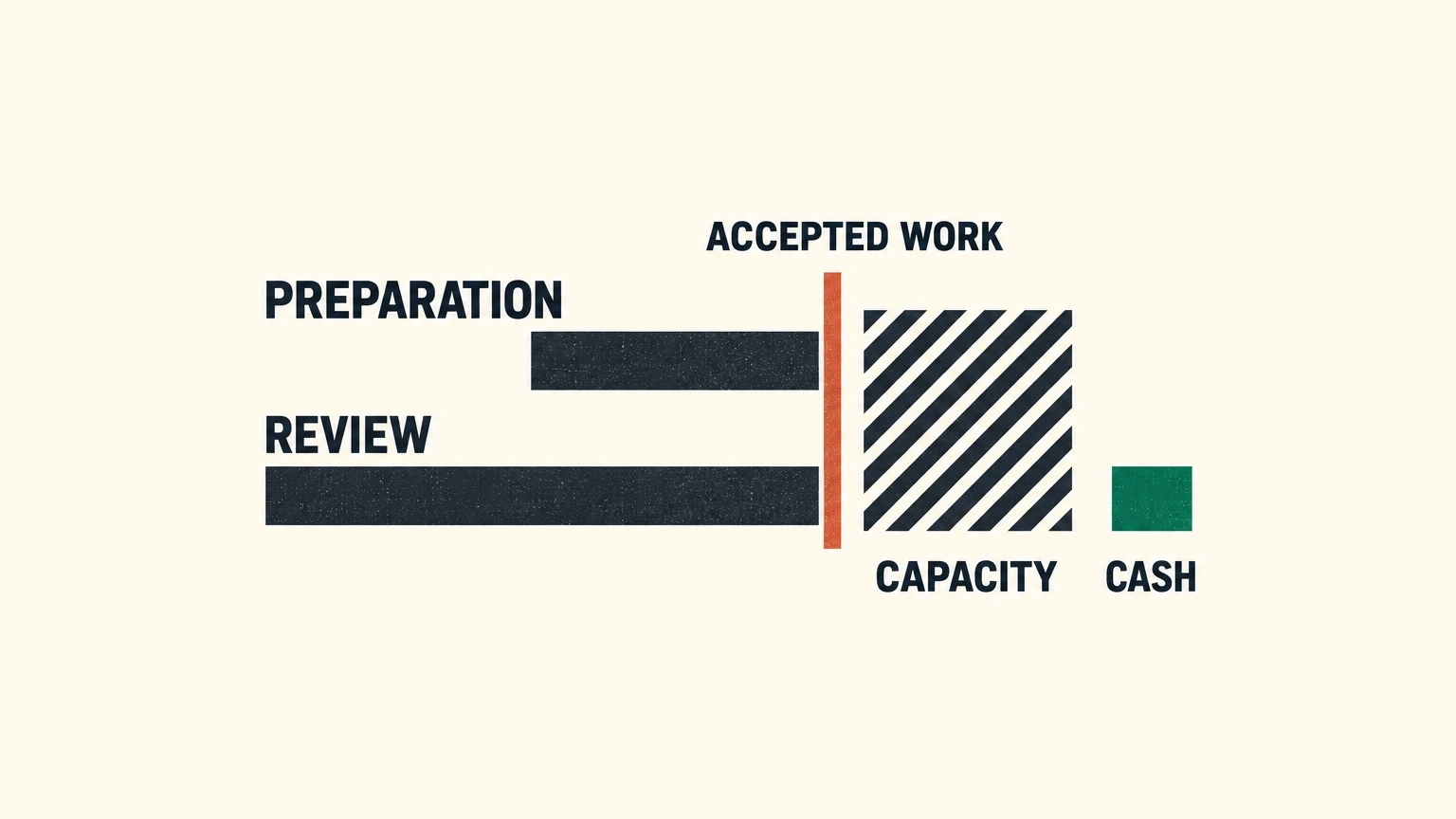
Accounting automation pays back only if accepted work costs less after preparation, review, rework and recurring costs—and the freed time becomes avoided spend or usable contribution. A calculation can expose fragile assumptions. It cannot establish that a tool will save time. This model shows how the same assumed preparation improvement can produce positive or negative economics.
The intended reader is a CPA managing partner or CAS leader deciding what to measure before funding one bounded workflow. We ran this economic model on October 10, 2026. Every workload, effort, rate and cost input is a hypothetical US-dollar assumption; no staff observations, customer records or vendor results go into it.
The model: count accepted work and keep roles separate
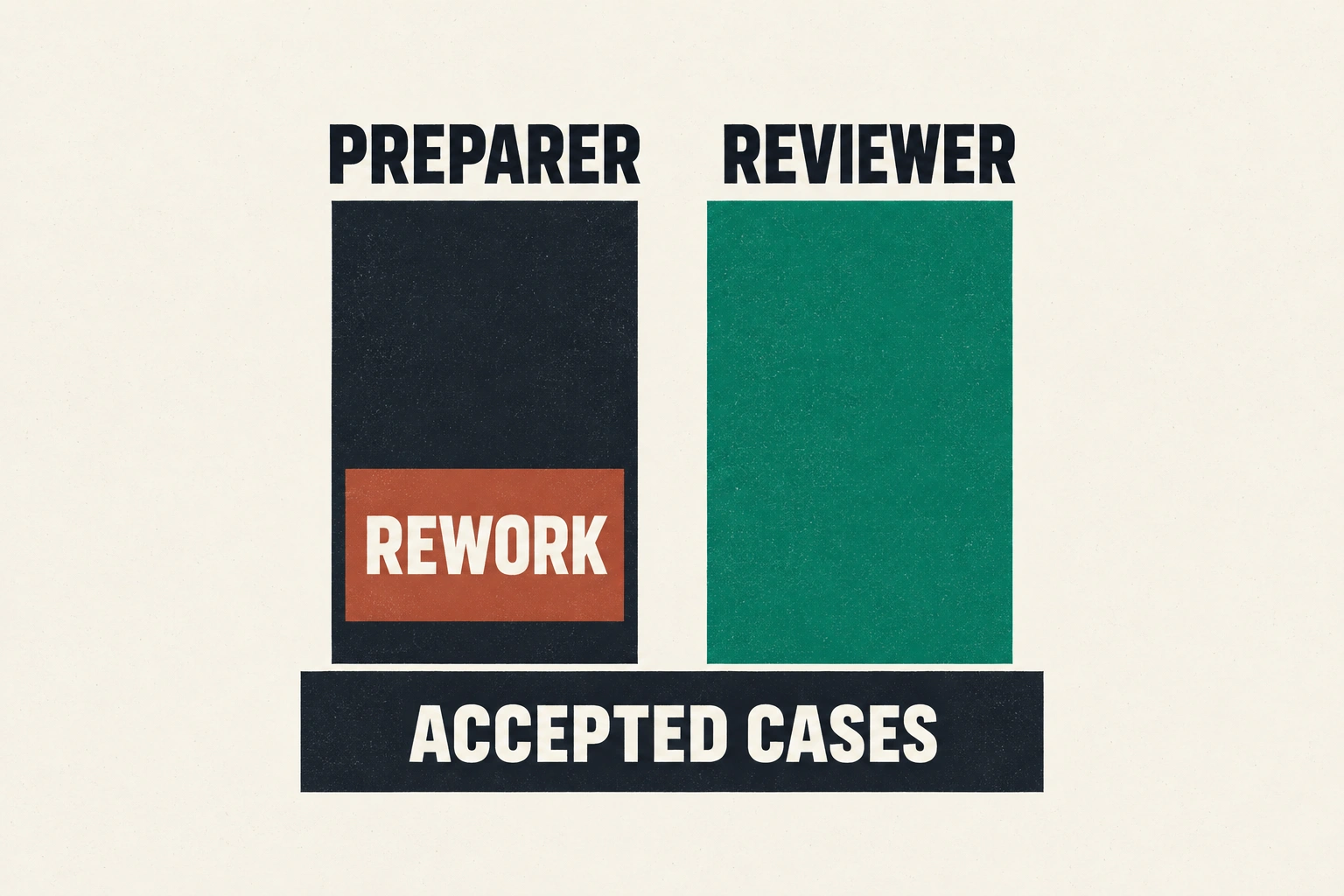
The unit is one accepted case of comparable scope and quality. A case might be an unsent invoice draft or a reconciled exception packet. Count a case once. Include the effort spent on retries, corrections, rejected attempts and manual fallback in the total effort needed to reach the accepted workload. Do not divide only by successful automated attempts and silently discard the rest.
For this deliberately small model, the rework input is average preparer correction effort per accepted case. It is not an error rate or the duration of each correction. Reviewer follow-up belongs in the review input. An escalation is not automatically a correction; classify the active work rather than the event label. Machine runtime and elapsed turnaround are not staff handling minutes.
The baseline assumes 30 preparer minutes and 10 reviewer minutes per accepted case. The assisted case assumes 8 preparer minutes before rework. These are chosen values, not measured productivity. The grid varies every combination below; there is no selected sample of firms.
| Input | Values used | Meaning and boundary |
|---|---|---|
| Accepted cases/month | 50, 200, 500 | Constant comparable workload |
| Assisted review minutes/case | 5, 15, 30 | All active reviewer effort |
| Preparer rework minutes/case | 0, 10, 30 | Average across accepted workload |
| Preparer cost/hour | $45 | Hypothetical labor-cost valuation, not billing rate |
| Reviewer cost/hour | $120 | Hypothetical labor-cost valuation, not billing rate |
| Recurring cost/month | $250, $750, $1,500 | Software, operation and monitoring combined |
| Realization fraction | 0%, 25%, 50%, 100% | Assumed conversion, not observed utilization |
| Implementation cost | $3,000, $12,000 | Setup, integration and training combined |
| New-work contribution/hour | $80 | Hypothetical incremental contribution, not revenue |
There are 648 configurations: three volumes × three review burdens × three rework burdens × three recurring costs × four realization fractions × two implementation costs. The implementation dimension repeats each operating configuration with two simple payback amounts; it does not independently change monthly benefit. Grid counts are not probabilities or a success rate.
Calculation and reproducibility
Let N be accepted cases per month, R assisted reviewer minutes, and W preparer rework minutes. Preparer hours released are `Hp = N × (30 − 8 − W) / 60`. Reviewer hours released are `Hr = N × (10 − R) / 60`. Either can be negative. Net capacity is `Hp + Hr`, but those roles are not interchangeable.
Positive labor value is `P = max(Hp, 0) × 45 + max(Hr, 0) × 120`. Extra labor cost is `E = max(−Hp, 0) × 45 + max(−Hr, 0) × 120`. The labor-value proxy is `P − E − recurring cost`; it is not cash savings.
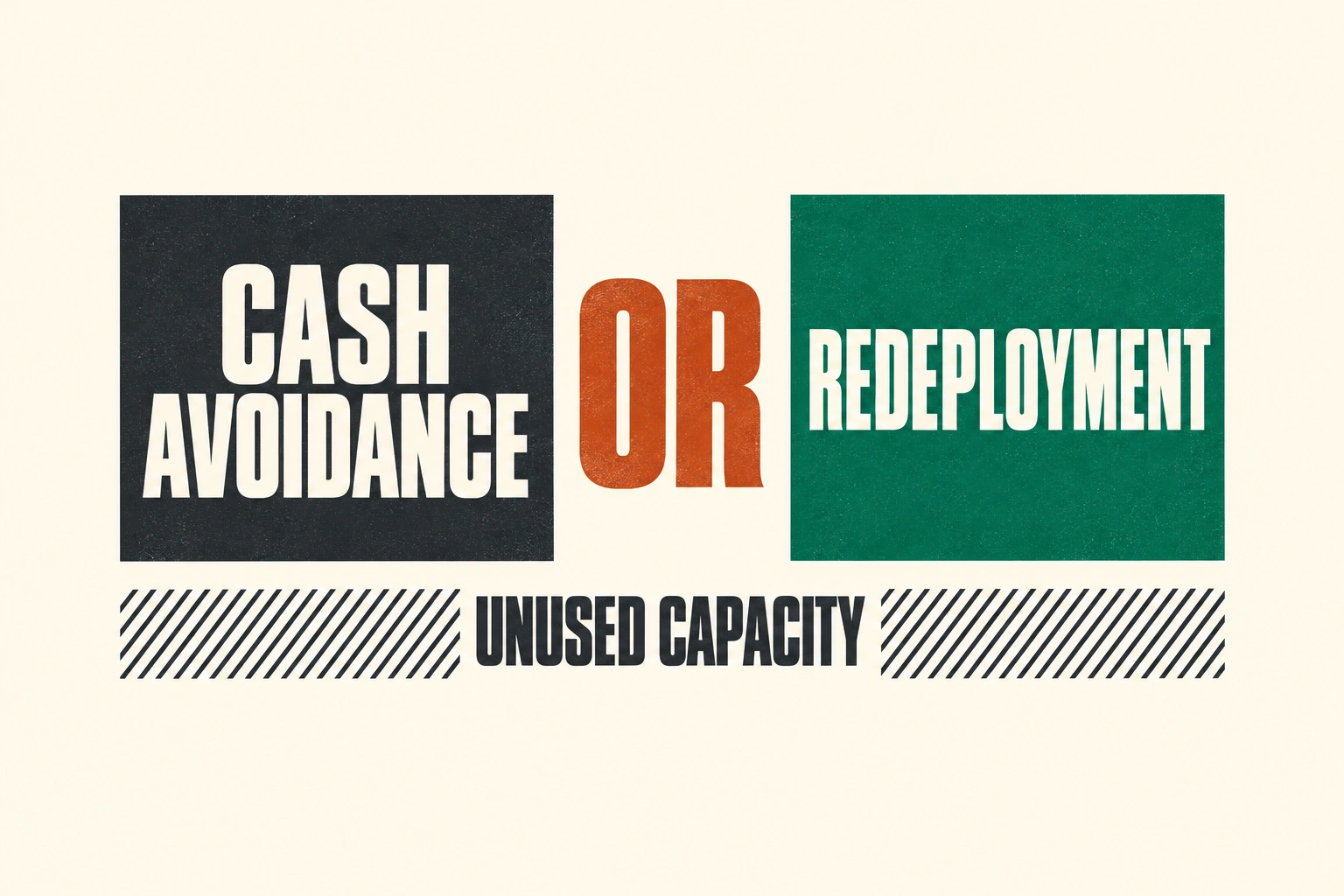
For realization fraction U, the alternative cash-avoidance scenario is `P × U − E − recurring cost`. It assumes the stated fraction of positive labor value actually avoids expenditure; salaried time released without a spending change does not satisfy that assumption. Negative role deltas are charged in full as an economic burden even at zero realization. Their valuation need not be incremental payroll cash in a real firm: this is a conservative budgeting model, not a cash-flow forecast.
The alternative redeployment scenario uses positive preparer hours only when reviewer capacity has not fallen: `eligible hours × U × 80 − E − recurring cost`. Eligible hours are `max(Hp, 0)` if `Hr ≥ 0`, otherwise zero. This conservative gate does not prove sufficient reviewer capacity for new engagements; the additional work's actual review requirement still needs measurement. Contribution means incremental receipts less the incremental costs of new work, excluding the recovered labor and recurring automation costs already treated here. Do not add this scenario to cash avoidance for the same hours.
Simple payback is implementation cost divided by positive monthly scenario benefit. At zero or negative benefit there is no finite payback under these assumptions, not a negative payback period. No ramp-up, discounting, inflation, tax, seasonality, liability loss or quality change is modeled.
Download the standard-library Python calculation, all 648 CSV configurations and dated inputs and results. Run `python3 accepted_work_sensitivity.py --out output` in a directory of your choosing. Two executions on October 10 produced byte-identical CSV output. The grid is deterministic; output timestamps differ. CSV SHA-256: `cac9cb049736e815c5dffa5f893e0cab7995f067e6037ac7bfce20fd0ccda9db`.
What changed the modeled investment decision
The reference configuration produces positive monthly benefit only because several favorable assumptions are supplied together. It uses 200 accepted cases, 5 reviewer minutes, 10 rework minutes, $750 recurring cost, 50% realization and $12,000 implementation. That releases 40 preparer hours and about 16.67 reviewer hours. The full labor-value proxy is $3,050 after recurring cost; the 50%-realized cash-avoidance scenario is only $1,150. Calling the larger number realized savings would change the decision without changing the work.
The following configurations change one operating assumption at a time from that reference. Dollar values are calculated hypothetical monthly net benefit, not observed savings. Simple payback is rounded to two decimals; complete precision is in the CSV.
| Configuration | Cash-avoidance net | Redeployment net | Cash / redeployment payback |
|---|---|---|---|
| Reference assumptions | $1,150 | $850 | 10.43 / 14.12 months |
| Realization falls to 0% | −$750 | −$750 | No finite payback |
| Review rises to 15 min/case | −$1,850 | −$2,750 | No finite payback |
| Rework rises to 30 min/case | −$950 | −$1,950 | No finite payback |
| Recurring cost rises to $1,500 | $400 | $100 | 30 / 120 months |
| Volume falls to 50 cases/month | −$275 | −$350 | No finite payback |
At 15 review minutes, the preparer still releases 40 hours, but the reviewer needs about 16.67 additional hours. Net capacity remains positive at about 23.33 hours. The cash-avoidance scenario is nevertheless negative because higher-cost reviewer work absorbs the assumed preparer benefit. The redeployment gate also closes. A blended saved-hours number would hide this bottleneck.
Across the chosen grid, cash avoidance is positive in 104 configurations and nonpositive in 544; redeployment is positive in 82 and nonpositive in 566. Cash-avoidance net ranges from −$24,500 to $13,000 per month. These counts and extremes describe only the deliberately selected input grid. They do not estimate the likelihood of automation paying back, typical firm savings or a vendor's reliability.
What to replace with measured evidence
The useful next step is not to adopt the reference result. Replace its assumptions with a matched baseline and a bounded pilot record:
- Record all active effort by role, including correction and manual fallback, over comparable scope and workload. Retain failures in the accounting, not only successful outputs.
- Establish the quality and control acceptance criteria first. A cheaper output that cannot be accepted is not an economic win. Use the accounting AI pilot acceptance record for that separate decision.
- Identify an actual spending change for the cash scenario, or demand, contribution and role-specific delivery capacity for redeployment. If neither is supported, report recovered capacity and unknown realized benefit.
- Capture implementation, training, integration, recurring software, oversight and exception-handling costs without double-counting staff effort. Add ramp-up and time-value assumptions when the investment horizon warrants them.
- Keep an unresolved risk or quality failure as a hold condition, rather than assigning it a convenient invented dollar value.
Public discussion already recognizes the burden. Thomson Reuters' October 7 article frames rework and supervision as hidden AI costs. Its August 5 accounting ROI framework compares baseline and assisted effort and includes training and change management. These are vendor-authored sources, not independent proof that any particular tool will reduce your firm's review time. Their examples and performance claims were not used as inputs here.
The CPA AI readiness assessment guide helps decide which workflow is ready to evaluate. The billing implementation guide explains why rules must be resolved before estimating effort. This article addresses the narrower economic question; a positive model does not grant deployment permission.
Fixed Labs provides assessments and implementation advice. Book a discovery call to scope one workflow, its baseline, review burden and evidence needed to replace the assumptions. The model is a way to make that conversation precise—not a promise of savings or a substitute for professional judgment.
Frequently asked questions
What ROI can an accounting firm expect from AI automation?
It depends on assumptions you have to measure in your own workflow. Automation pays back only if accepted work costs less after preparation, review, rework and recurring costs, and the freed time becomes avoided spending or usable contribution. In the Fixed Labs model of 648 hypothetical configurations, the same assumed preparation improvement produced both positive and negative monthly results.
How much does reviewer time affect AI savings in accounting?
Enough to reverse the result. In the model’s reference configuration, raising assisted review from 5 to 15 minutes per case turned a hypothetical $1,150 monthly cash-avoidance benefit into a $1,850 monthly loss, even though preparers still released 40 hours. The model values reviewer time at a hypothetical $120 per hour against $45 for preparers, so the extra review absorbs the preparation gain.
Is time saved by AI the same as money saved?
No. Released hours become cash only if spending actually changes, or become value only if they are redeployed into new work with real demand and enough reviewer capacity. The same hour should not be counted both ways. In the model’s reference case, the full labor-value proxy was $3,050 a month, while the 50%-realized cash-avoidance scenario was $1,150. Salaried time freed without a spending change is capacity, not savings.
How long does accounting AI automation take to pay back?
It depends on implementation cost and realized monthly benefit, and under some assumptions it never pays back. In the model’s reference configuration, a hypothetical $12,000 implementation paid back in about 10.4 months under cash avoidance or 14.1 months under redeployment. Raising recurring cost to $1,500 stretched those to 30 and 120 months, while zero realization, 15 review minutes or 30 rework minutes per case produced no finite payback.
What should I measure before building an AI business case for my firm?
Measure active effort by role, including corrections and manual fallback, on comparable work and quality, and keep failed attempts in the count. Set quality and control acceptance criteria first. Then identify a real spending change, or demand and reviewer capacity for redeployed hours, and capture implementation, training, integration, software, oversight and exception-handling costs without double-counting staff time. If realized benefit is unsupported, report recovered capacity with an unknown financial benefit.
Who helps accounting firms estimate the ROI of an AI workflow?
Fixed Labs provides assessments and implementation advice and can scope an AI assessment around one workflow: its baseline, its review burden and the evidence needed to replace modeled assumptions. The Fixed Labs AI assessment includes a plain-English ROI calculation covering hours returned per week, estimated monthly net ROI and total tool cost, and every engagement starts with a discovery call booked at fixedlabs.ai/contact. The model makes that conversation precise; it isn’t a promise of savings.