AI Readiness Assessment for CPA Firms: Pilot Gates
An AI readiness assessment for a CPA firm should evaluate one recurring workflow, not declare the whole firm ready. Score its procedure, inputs, review, access and business value. Then apply hard gates: authorized data access, a named reviewer, a stop path and a measurable baseline. A high score cannot override a missing gate.
Book a discovery call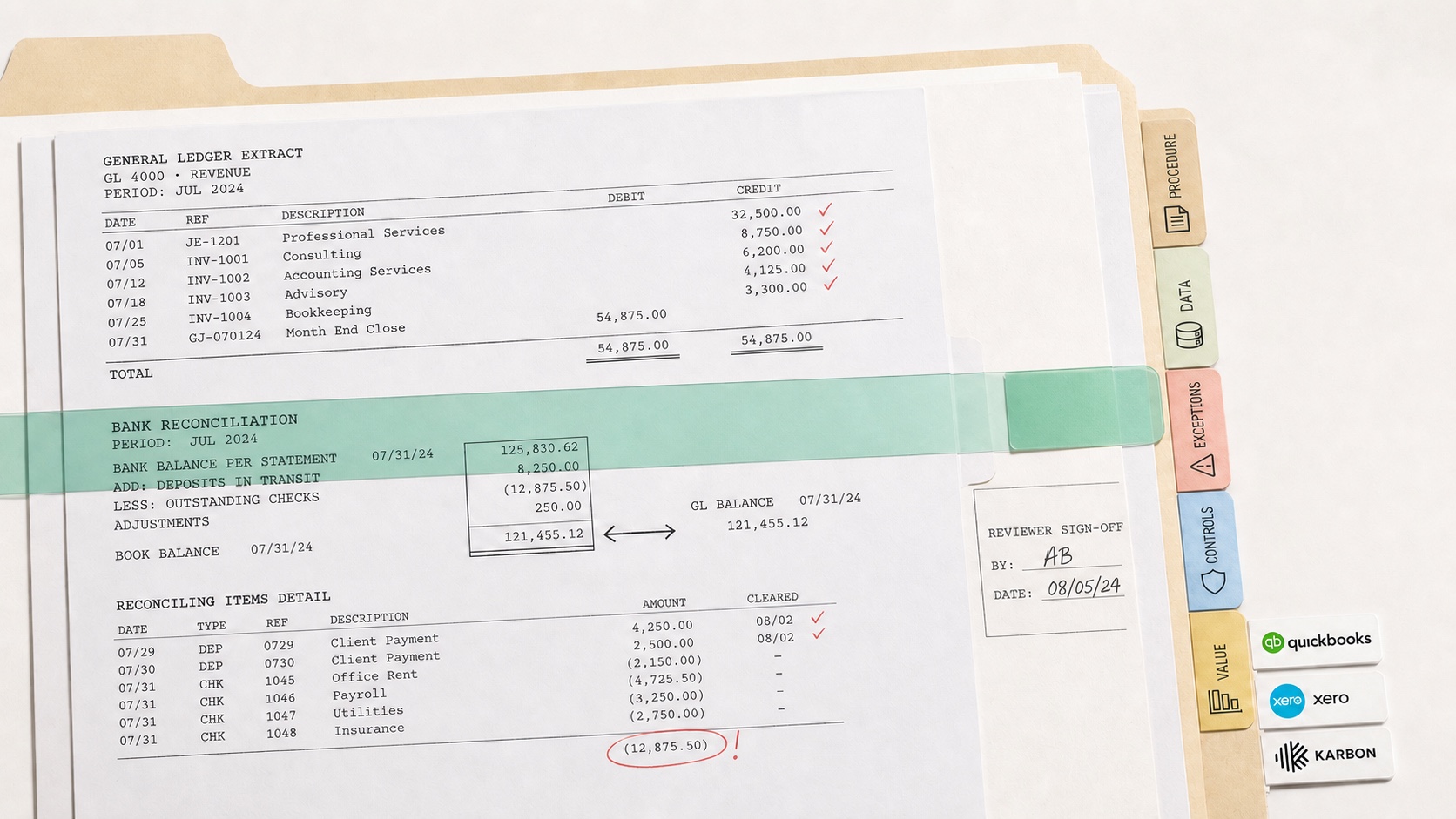
Updated October 13, 2026: the scorecard now includes four mandatory pilot gates, a blank worksheet and an executed decision model.
What Is an AI Readiness Assessment for a CPA Firm?
An AI readiness assessment for a CPA firm determines which accounting workflows are prepared for AI, which need foundation work, and which should remain human-led. The useful unit of analysis is not the entire firm and not a list of software. It is one recurring workflow at a time.
Score each workflow on five things: how well the process is documented, whether inputs are reliable, whether exceptions and review rules are explicit, whether system access can be controlled, and whether the business value can be measured. A high score means the workflow may be ready for a bounded pilot. A low score tells you exactly what to repair first.
That distinction matters. An accounting firm can be technologically modern and still be unready to automate a specific process because the real procedure lives only in one employee's head. Another firm can use an imperfect stack and still run a strong pilot because the workflow, evidence, review boundary, and definition of done are clear.
How Do You Score AI Readiness in an Accounting Firm?
Use this Fixed Labs 100-point workflow scorecard. It is an assessment framework, not an industry benchmark. Give points only when the firm can show current evidence—not when someone says a control or procedure probably exists.
| Readiness dimension | Weight | Evidence to inspect | What a low score means |
|---|---|---|---|
| Documented procedure | 25 | Current recording, step-by-step procedure, owner, trigger, output, definition of done | The agent would be asked to guess how the work is performed |
| Inputs and data quality | 20 | Required fields, naming rules, source systems, sample files, missing-data patterns | Runs will stop, branch unpredictably, or produce weak outputs |
| Exceptions and human review | 20 | Exception list, decision rules, approval points, escalation owner, turnaround target | The workflow has no safe boundary for uncertainty or judgment |
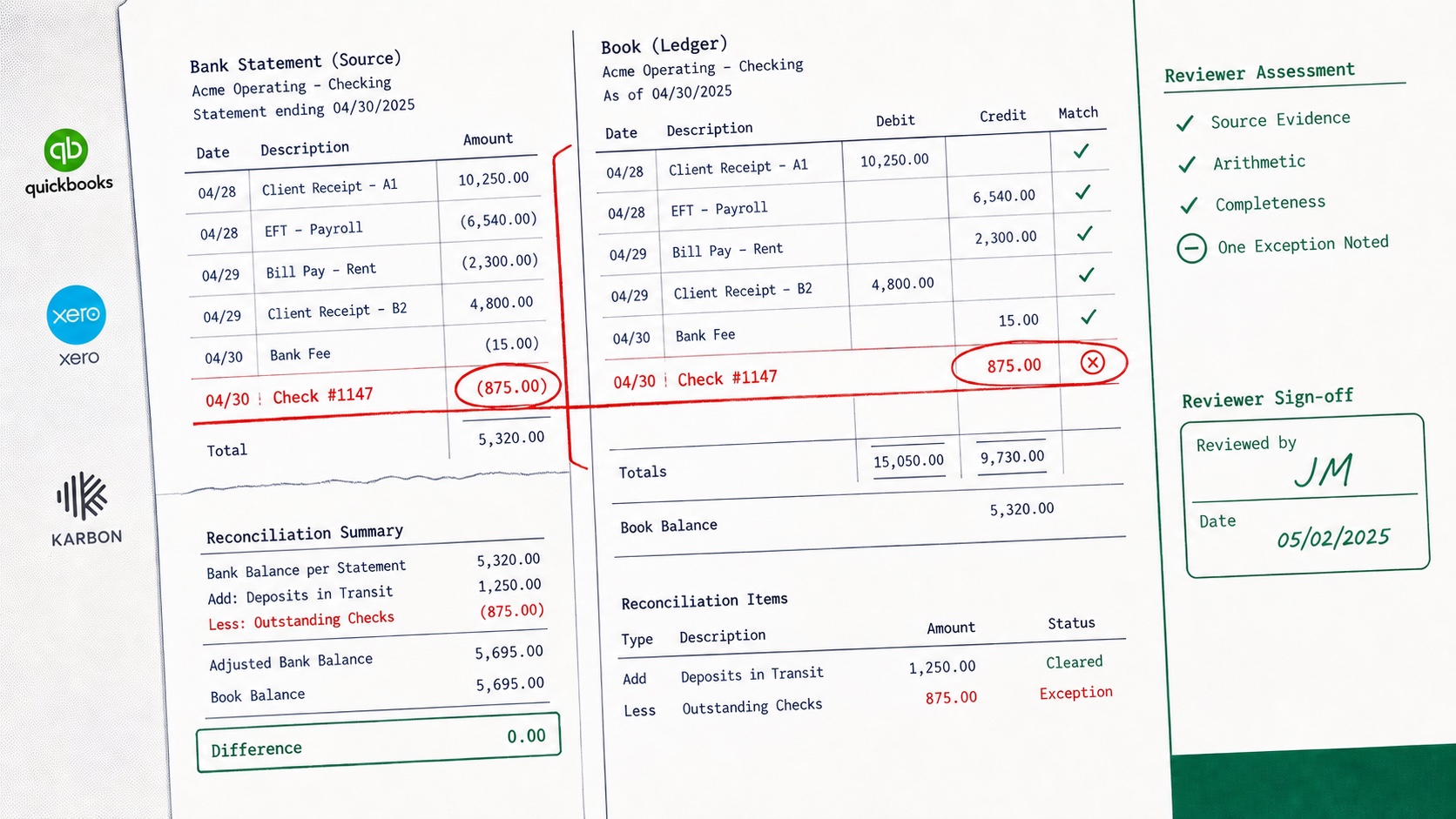
| Access, security, and auditability | 20 | Role-based access, least privilege, credential handling, action logs, retention rules | The workflow may expose more data or authority than it needs |
| Business value and measurement | 15 | Volume, cycle time, labor, rework, backlog, error baseline, target outcome | The pilot can run without proving that it helped the firm |
| Total | 100 | A complete evidence packet for one workflow | A defensible pilot decision |
What Does the Readiness Score Mean?
| Score | Decision | Next move |
|---|---|---|
| 0–39 | Foundation first | Observe the work, standardize it, clean inputs, and establish basic controls |
| 40–69 | Redesign before pilot | Resolve the weakest dimensions and test the revised procedure manually |
| 70–84 | Bounded-pilot candidate if all gates pass | Use a limited workload, human review, logs, and explicit success measures |
| 85–100 | Candidate for controlled scale after pilot evidence | Expand only after the pilot proves quality, reliability, and economic value |
Do not average weak controls away with a strong business case. A workflow that scores well on value but poorly on access or review should not move into production. Apply all four gates below before any pilot, then verify actual pilot outputs before expanding.
Can a high readiness score still mean hold?
Yes. A score summarizes evidence; it does not grant authority. A workflow that totals 100 points still needs to pause if nobody is named to review consequential outputs. Treat the numeric thresholds below as Fixed Labs planning recommendations, not a validated prediction of safety, regulatory compliance or financial return.
Before calling a workflow a pilot candidate, resolve these four gates:
| Hard gate | Evidence needed | Hold when |
|---|---|---|
| Authorized data access | Agreed input scope, permitted systems and accountable access owner | The firm has not authorized the proposed records or action scope |
| Named reviewer | Person responsible for consequential output and a backup | Approval is assigned to a team name with no accountable person |
| Stop and escalation path | Conditions that pause work, destination and recovery owner | Missing data or ambiguous instructions can continue silently |
| Measurable baseline | Current accepted-work volume, human effort and rework definition | Nobody can compare pilot work with the existing process |
A passed gate means the required evidence is documented for the proposed scope. It is not a blanket authorization to send invoices, post adjustments or give tax advice. The firm still decides which actions require explicit approval.
A worked example: the score is not the decision
We ran the downloadable decision model against four hypothetical workflow scenarios to check the arithmetic and the decision rules.
| Scenario | Total | Gates | Planning decision |
|---|---|---|---|
| High score without a reviewer | 100 | Named reviewer missing | Hold; appoint the reviewer before a pilot |
| Document intake pilot | 80 | All four documented | Bounded-pilot candidate |
| Strong controls, weak documentation | 63 | All four documented | Redesign procedure and inputs first |
| Draft billing pilot | 89 | All four documented | Candidate for controlled scale only after pilot evidence |
The last row is not permission to skip a pilot. It separates readiness to evaluate expansion from demonstrated production reliability. Use the pilot acceptance decision record after observed pilot work, and the AI economics sensitivity model for hypothetical costs—not promised savings.
Download the blank readiness worksheet, sample inputs, calculation script and executed results. The five dimension limits are 25, 20, 20, 20 and 15; incomplete gates override every score band. Record the evidence supporting each score and avoid uploading client details to a public tool.
Want a second view of the weakest gate? Book a discovery call. Bring a description of one workflow, its systems and its recurring exceptions; you do not need to send client records for the initial conversation.
Should You Assess the Whole Firm or One Workflow?
Do both, in the right order. Begin with a firm-level inventory to find recurring work, then assess each candidate workflow separately. “Tax,” “bookkeeping,” and “client service” are departments, not automatable procedures.
A useful inventory names concrete workflows such as:
- Drafting invoices from approved time and billing records
- Reviewing monthly books and routing anomalies to a manager
- Filing statements into the correct client and account records
- Creating new-client records across practice-management and document systems
- Monitoring unbilled work and aged work in progress
- Preparing a controlled payment-recording report
- Assembling a verified tax-notice intake packet
- Refreshing an operations, capacity, or staffing dashboard
Each can have a different score inside the same firm. This is why a single “your firm is 72% AI-ready” result is less useful than a portfolio that shows where to pilot, where to repair, and where not to automate.
Why Detailed Process Documentation Comes Before AI Agents
For a firsthand implementation example, see how Fixed Labs documented billing rules inside an accounting team’s Cliq channels, then brought the workflow into supervised operation through Susan.
A strong starting point for AI agents is detailed, current, and documented processes. AI does not remove the need for operating discipline. It exposes where that discipline is missing.
If two employees complete the same workflow differently, if exception rules change depending on who is available, or if the reviewer knows a dozen unwritten checks, the agent does not have a stable job to learn. The first investment is not a model or automation tool. It is capturing how the work actually happens.
What Should a CPA Firm Document Before Automating a Workflow?
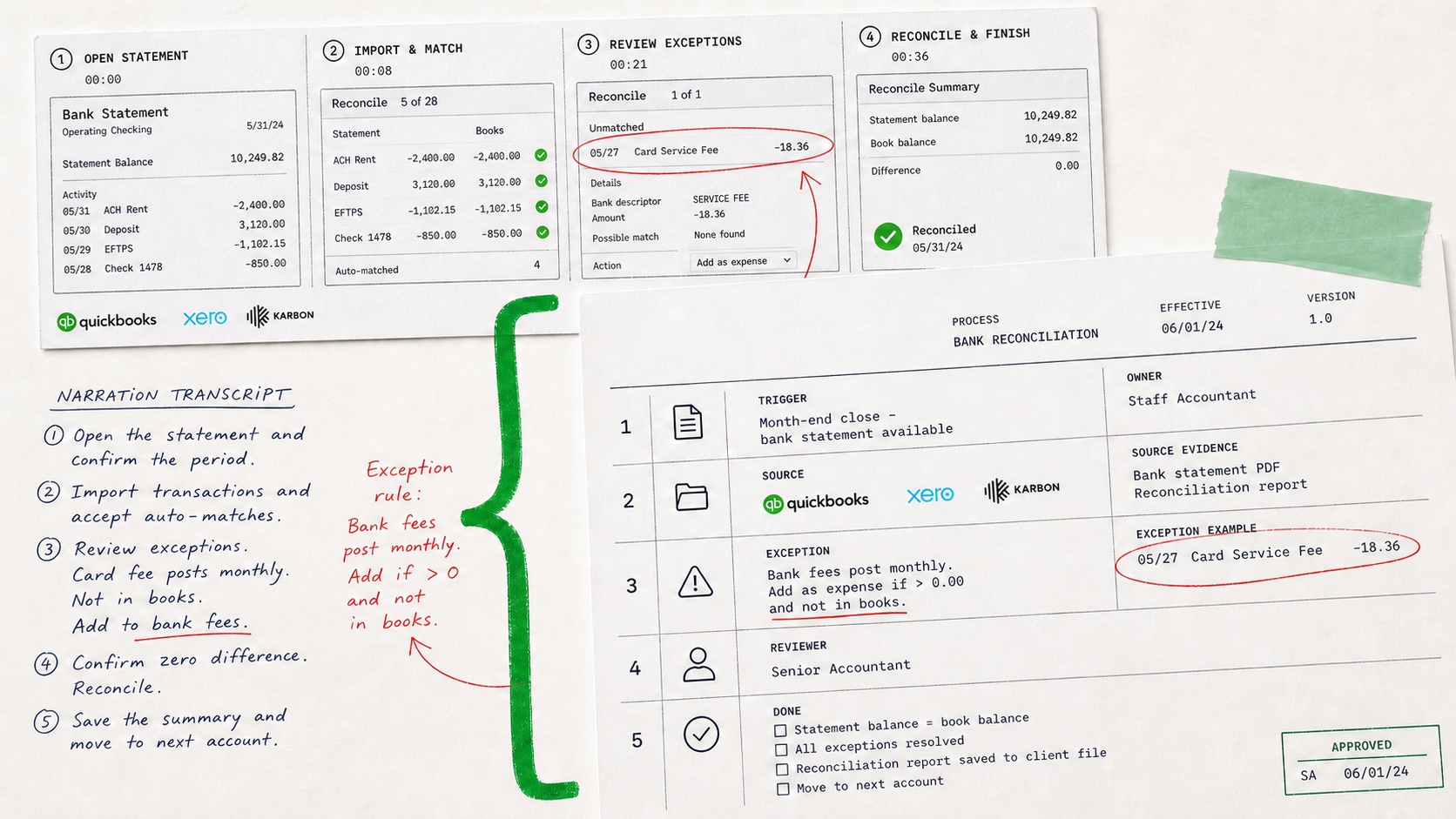
Record the full workflow while an experienced employee performs it. Screen recording is useful for software steps; narration is useful for judgment and hidden context. The recording is raw evidence, not the final procedure. Convert it into an approved operating document that another trained person can follow.
Capture all of the following:
- Trigger: What event, schedule, status, email, or file starts the work?
- Inputs: Which records, fields, documents, credentials, and prior-period information are required?
- Sequence: What is the exact order of actions across every system?
- Decision rules: Which checks determine the next step?
- Exceptions: What can be missing, ambiguous, duplicated, late, or inconsistent?
- Permitted actions: What may the agent read, draft, change, upload, submit, or never do?
- Evidence: What record, file, link, timestamp, or readback proves completion?
- Review: Who approves consequential work, and what do they verify?
- Escalation: When must the workflow stop, who owns the exception, and how quickly should they respond?
- Definition of done: What must be true before the run can be closed?
Do not permit critical process knowledge to live only in employees' heads. That creates key-person risk even if the firm never deploys AI. When people leave, change roles, or become unavailable during a deadline, undocumented judgment leaves with them.
Is a Written SOP Enough for an AI Agent?
Usually not. A useful agent-ready procedure combines four forms of evidence:
| Artifact | What it reveals |
|---|---|
| Screen or desktop recording | The actual clicks, searches, downloads, uploads, and system transitions |
| Narrated walkthrough | Why the operator makes decisions that are invisible on screen |
| Written operating procedure | The approved sequence, roles, rules, and boundaries |
| Exception library | Real edge cases, expected treatment, and when human judgment is required |
Written procedures often describe the happy path. Real work contains missing statements, duplicate files, mismatched client names, unusual account structures, stale permissions, and deadlines that change the order of operations. The exception library is frequently the difference between a good demo and dependable work.
How Should CPA Firms Handle Human Review?
Human review should be designed into the workflow, not added after a mistake. Define which actions are reversible, which affect a client or financial record, and which require professional judgment.
The CPA.com AI solution due diligence guide introduces questions on data privacy, model accuracy, security and governance, with an evidence checklist. The NIST AI Risk Management Framework is voluntary guidance for managing AI risk, not a certification or a declaration that a particular workflow is safe. For an accounting workflow, those ideas become practical questions: who owns the agent, what can it touch, how is each action evidenced, and who can stop or reverse it?
A draft invoice can be prepared and held for approval. A suspected bookkeeping issue can be flagged without changing the books. A tax notice packet can be assembled without deciding the substantive response. Good workflow design separates preparation from judgment and uses the agent to make the human review faster and better informed.
How to Choose and Run the First CPA-Firm AI Pilot
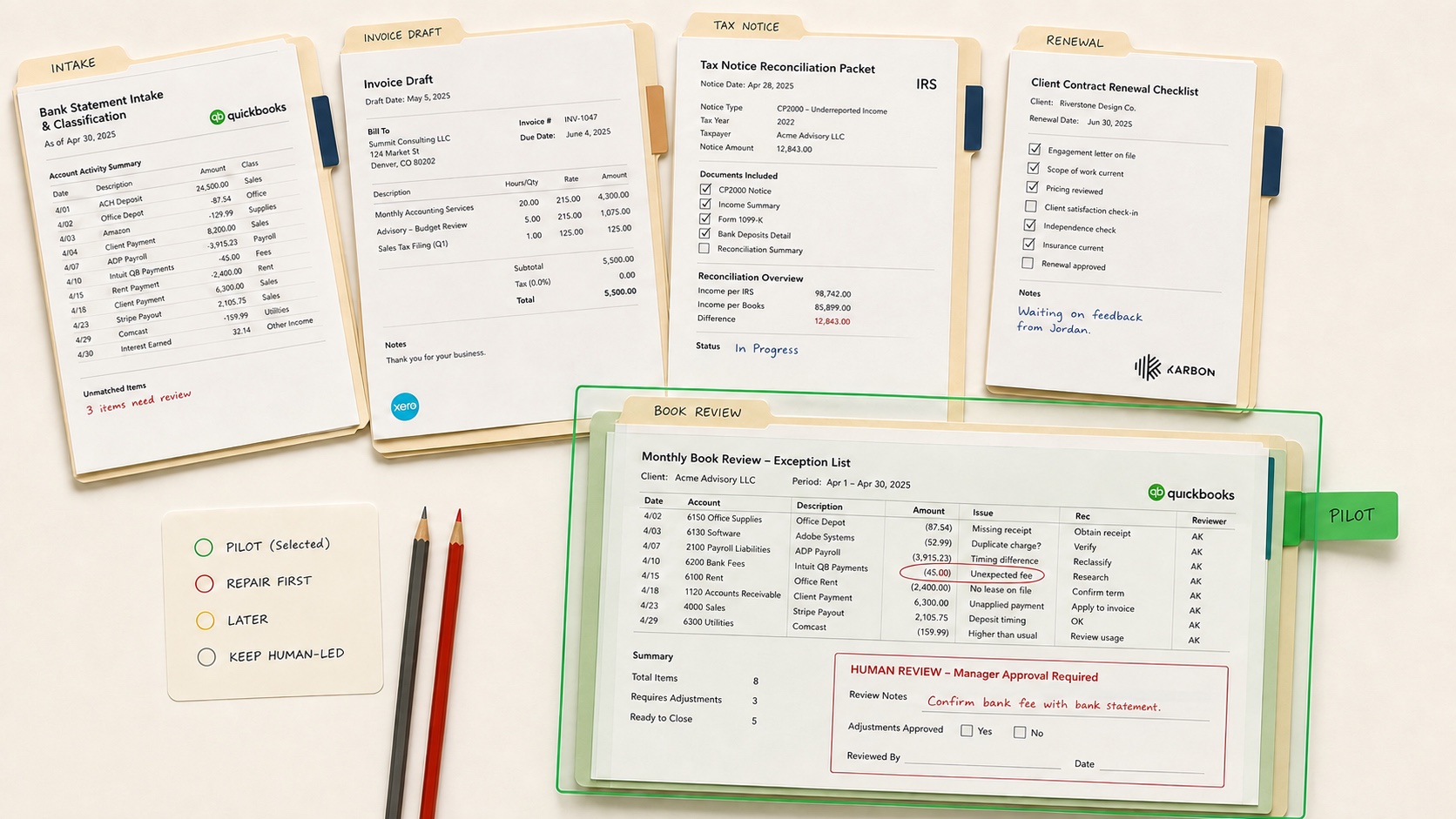
Choose the first pilot by combining readiness with value. The most annoying task is not always the best first automation. The best candidate is repetitive, frequent, evidence-rich, bounded, and costly enough to measure—but safe enough to review before consequences occur.
Which Accounting Workflows Are Good First AI-Agent Candidates?
| Workflow pattern | Why it can fit | Boundary to preserve |
|---|---|---|
| Document intake and classification | High volume, visible inputs, verifiable filing result | Route uncertain identity or destination to a person |
| Invoice drafting | Clear source records and reviewable draft output | Human approval before sending or posting |
| Monthly book review | Repeatable checks can produce an exception queue | Manager decides adjustments and client communication |
| Client onboarding coordination | Defined records and folders across several systems | Escalate ownership conflicts and missing authorization |
| Work-in-progress monitoring | Recurring calculations and follow-up queues | Do not invoice, write off, or record payments without authority |
| Tax-notice intake | A checklist can assemble verified documents and consent | Do not determine the substantive response without qualified review |
| Operations reporting | Source systems and expected metrics can be named | Preserve source systems and flag inconsistent data |
These examples describe workflow shapes, not promises that every firm should automate them. The current procedure, systems, client obligations, and control environment determine readiness.
What Metrics Should a CPA AI Pilot Track?
Define the baseline before the pilot. Then measure the result on accepted work, not model activity.
| Metric | Baseline question | Pilot evidence |
|---|---|---|
| Cycle time | How long from trigger to reviewed completion today? | Median time for accepted pilot runs |
| Human effort | How many staff and reviewer minutes are required? | Active handling and review time per accepted run |
| First-pass acceptance | How often is the output accepted without correction? | Reviewer disposition and correction reason |
| Exception quality | Are unusual cases detected and routed correctly? | True exceptions, missed exceptions, and false alarms |
| Rework | How much cleanup does the agent create? | Correction minutes and repeated failure categories |
| Reliability | Does it finish on schedule and provide evidence? | Completed, failed, retried, and escalated runs |
| Economic value | Does recovered capacity justify ongoing operation? | Value of accepted time saved minus review and operating cost |
CPA.com's 2025 AI in Accounting Report recommends starting with a firm-wide readiness assessment, auditing high-friction workflows, selecting a small number of high-value use cases, tracking business-aligned metrics, and keeping human oversight in agentic workflows. The Fixed Labs scorecard turns that direction into a workflow-by-workflow evidence test.
How Long Should an AI Readiness Assessment Take?
A self-assessment can identify obvious gaps in a few hours if the evidence already exists. A decision-grade assessment takes longer because it includes interviews, recordings, sample inputs, current procedures, system access, exception history, and baseline metrics. The goal is not to spend weeks creating a strategy presentation. It is to produce enough evidence to choose and scope the first pilot responsibly.
What Should the Assessment Deliver?
A CPA firm should leave with:
- A workflow inventory ranked by readiness and value
- A scorecard and evidence notes for each leading candidate
- A process-documentation gap list
- A data, access, and control gap list
- One recommended bounded pilot with a definition of done
- Human-review and escalation boundaries
- Baseline metrics and a measurement plan
- A sequenced roadmap for foundation work, pilots, and later scale
If the deliverable is only a software list, the assessment is incomplete. Tools should follow the workflow decision.
What Is the Next Step for a CPA Firm?
Start with one process your team performs every week. Record it end to end, collect the current procedure and exceptions, then score it with the five dimensions above. If the score exposes gaps, repair them before buying another tool. If the evidence supports a pilot, limit the scope and require visible review.
Fixed Labs offers AI assessments for operators who want an outside team to map the opportunity, identify the safest high-value starting point, and turn it into an implementation roadmap. To talk through the workflow you scored, book a discovery call. You can also review our CPA-firm assessment focus and the distinction between an assessment and managed AI agents.
QuickBooks, Xero, and Karbon are trademarks of their respective owners and appear here only as examples of systems CPA firms may use. No endorsement or partnership is implied.
Once a bounded pilot has produced evidence, use the accounting AI pilot acceptance decision record to document go, hold or stop for its next scope. Readiness and implementation preparation do not themselves authorize deployment.
Before treating recovered time as an investment return, use the accounting AI economics benchmark to examine review, rework and realization assumptions. The numbers are a model, not measurements.
For implementation choices beyond this scorecard, see AI for CPA firms. Before signing, use the vendor exit handover register to plan continuity. To map one workflow and its unresolved gates with Fixed Labs, book a discovery call.
When readiness gaps require an implementation partner, use the CPA AI consultant proposal and reference-call checklist. Give each bidder this same workflow boundary and unresolved readiness items; require evidence for reviewer effort, exception ownership and usable handover before comparing fees.
For a billing workflow that has cleared those readiness questions, use the CPA billing implementation scope ledger to separate native configuration, missing held-time rules and any historical-data migration that must be commissioned separately.
Turn readiness findings into a budget
Before requesting a fixed price, assign an owner to access gaps, unsettled rules and missing source records. Ask whether resolving each gap belongs in the implementation fee or remains the firm’s work. Use the first-workflow AI implementation cost breakdown to keep setup, ongoing service and internal review effort separate; then request comparable proposals for the same workflow.
Frequently asked questions
Is my accounting firm ready to use AI agents?
Assess readiness one recurring workflow at a time rather than for the whole firm. The Fixed Labs 100-point scorecard weights documented procedure at 25 points, inputs and data quality at 20, exceptions and human review at 20, access and auditability at 20, and measurable business value at 15. In this planning framework, 70 to 84 identifies a bounded-pilot candidate only after all four gates pass; below 40 needs foundation work first. Authorized access, a named reviewer, a stop path and a baseline are mandatory regardless of the total.
Why do AI agents struggle with accounting workflows?
An undocumented procedure is one preventable source of failure. If two employees complete the same workflow differently, exception rules change depending on who is available, or a reviewer applies unwritten checks, the workflow instructions may be unstable. Written procedures often describe only the happy path, while real work includes missing statements, duplicate files and mismatched client names. A documented exception library is frequently the difference between a good demo and dependable work.
Can a CPA firm run an AI readiness assessment on its own?
Yes, for a first pass. With the five-dimension scorecard, a firm can identify obvious gaps in a few hours if the evidence already exists: record one weekly process end to end, collect the current procedure and exceptions, and score it. A decision-grade assessment takes longer because it adds interviews, recordings, sample inputs, system access, exception history and baseline metrics, which are needed to choose and scope a first pilot responsibly.
Can AI replace professional judgment at a CPA firm?
Not in the approach this scorecard recommends. Good workflow design separates preparation from judgment: an agent can prepare a draft invoice and hold it for approval, flag a suspected bookkeeping issue without changing the books, or assemble a tax-notice packet without deciding the substantive response. Consequential actions stay with a named reviewer, and the agent’s job is to make that review faster and better informed.
What security questions should a CPA firm ask before giving AI access to client data?
Ask what the agent can access, how each action is evidenced and who can stop or reverse it. The scorecard looks for role-based access, least privilege, credential handling, action logs and retention rules. CPA.com’s guide identifies data privacy, model accuracy, security and governance as evaluation topics and includes an evidence checklist. A workflow that scores poorly on access should not move into production.
Who offers AI readiness assessments for CPA firms?
Fixed Labs offers AI assessments for operators who want an outside team to map the opportunity, identify the safest high-value starting point and turn it into an implementation roadmap. Every engagement starts with a discovery call, booked at fixedlabs.ai/contact, where the team learns how the firm operates and recommends the right next step. Fixed Labs also describes its CPA-firm assessment focus at fixedlabs.ai/industries/cpa-firms.