How much does AI implementation cost for a mid-sized company?
For a mid-sized company, budget AI implementation as a scoped first workflow, not a company-wide transformation or a software subscription. Get a fixed build quote, a monthly operating quote and an estimate of your staff’s time before approving spend; Fixed Labs does not publish a universal dollar price for this work.
Book a discovery call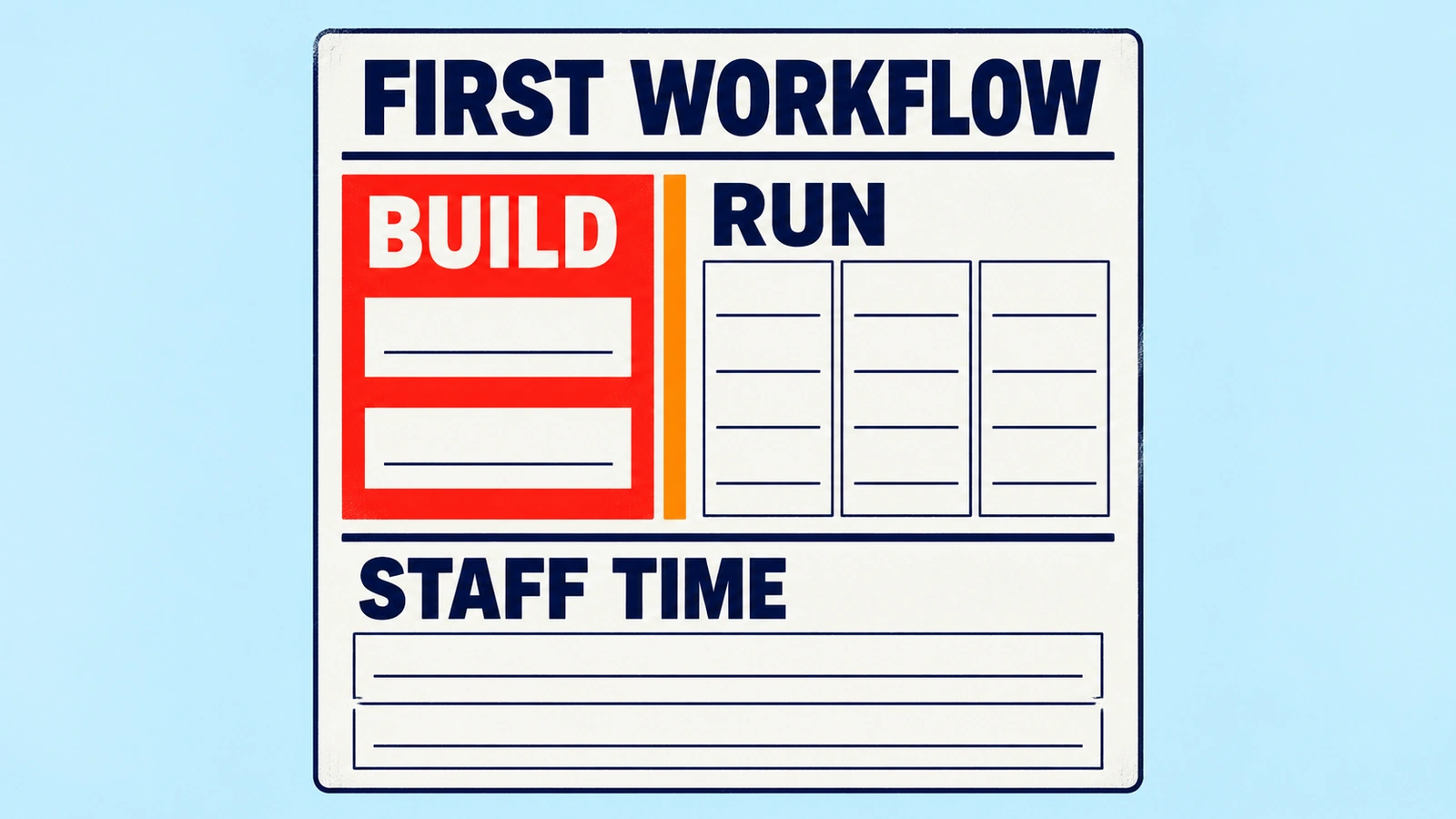
For a CFO or COO at an accounting, tax or advisory firm, the useful question is what it will cost to get one job working reliably in the systems you already use. This guide is for established businesses doing $5M+ in revenue, without an in-house AI team.
Key takeaways
- Separate the one-time build, recurring operation and your own team’s work.
- Ask for the same workflow, volume, approval steps and support period in every quote.
- Count review, corrections and rollout effort before calling saved time a saving.
- Start with one workflow whose current cost you can measure. Check existing software before commissioning a custom build.
Bring the job you want to improve, the systems involved and a rough monthly volume. Book a discovery call to find out what would need to be scoped, not to buy an unexplained price range.
What should an AI implementation budget include?
A useful budget includes everything required to get the work into production and keep it running. The model subscription is only one line. For example, preparing invoice drafts also requires agreed billing rules, access to source records, a review path, handling for missing information and someone responsible when a run fails.
Use this breakdown when requesting a proposal. Ask bidders to identify what is included in their fee so the same expense is not counted twice.
| Cost category | One-time work | Recurring work | Question to settle before approval |
|---|---|---|---|
| Discovery and workflow design | Map the job, rules, exceptions and success measures | Review material changes to the process | Who decides what correct work looks like? |
| Data and access | Map required fields, resolve missing inputs, obtain permission | Maintain access and investigate source changes | Is broader data cleanup excluded? |
| Build and integration | Connect the agreed systems and prepare the output | Maintain connections as systems change | Which exact read and write actions are covered? |
| Evaluation and rollout | Check normal and exception cases, train users, supervise launch | Check quality and investigate errors | Who accepts the work and who can pause it? |
| Software and usage | Any required setup or license changes | Model usage, hosting, storage and platform fees | Is there a usage allowance, cap or overage charge? |
| Operating support | Document instructions and escalation | Monitor runs, fix failures and improve the agreed workflow | What coverage and change work does the run fee include? |
| Firm staff time | Explain rules, approve access, review examples and learn the process | Review outputs, resolve exceptions and own policy | How many hours remain with the firm? |
The published Fixed Labs implementation service uses a fixed build fee plus a monthly fee to run and improve each workflow, quoted after discovery and before building. Ask which of the rows above are bundled, separately billed or retained by your firm. A fixed fee is useful only when its assumptions and exclusions are clear.
Why do quotes differ so much?
Quotes differ because companies are often buying different jobs under the same name. A draft prepared from a clean export is not the same assignment as a workflow that reads several systems, checks conflicting records and saves a reviewed result back to the right place.
For an accounting firm, settle these scope questions first:
- Where does the job end? An unsent invoice draft, an approved send and a payment workflow are different commitments.
- Which systems and records are included? Name the source of truth for clients, time, rates, agreements and status.
- Who decides exceptions? Held time and client-specific concessions need firm policy, not an implementer’s guess.
- What history moves? Opening receivables and historical WIP are separate unless the proposal expressly includes migration and reconciliation.
- What happens after launch? Specify monitoring, response coverage, supported changes and handover responsibilities.
In the published CPA billing engagement, Fixed Labs spent two weeks with the invoicing team documenting billing rules and exceptions before the supervised workflow. That observation shows why the business work belongs in the scope. It is not a standard discovery duration, a price benchmark or a promise that another firm has the same needs.
The CPA implementation page describes the broader accounting work. Use the consultant proposal comparison guide to put competing offers on the same basis before comparing fees.
A sample first-year cost breakdown you can copy
Take a sample project that prepares invoice drafts for human approval from agreed records. It excludes sending, payment collection and migration of old receivables. The amounts below are planning inputs chosen to show the arithmetic, not a client quote, a Fixed Labs price or a market average. Replace every input with a written quote or a measured staff estimate.
| Budget item | Sample assumption | Sample first-year amount |
|---|---|---|
| One-time vendor build, including discovery, agreed connections and rollout | $20,000 total | $20,000 |
| Internal setup effort | 40 hours at a $60 loaded hourly cost | $2,400 |
| Monthly vendor run fee | $1,000 for 12 operating months | $12,000 |
| Software and metered usage not included in the run fee | $200 for 12 operating months | $2,400 |
| Internal review and exceptions | 10 hours a month at $60 for 12 months | $7,200 |
| Total first-year economic cost | One-time costs plus 12 operating months | $44,000 |
The sample has $34,400 of vendor and software spend and $9,600 of internal time, giving $44,000 in total economic cost including $2,400 of internal setup time. Existing staff time is not necessarily additional cash expenditure. Your finance team should distinguish cash spend, capacity consumed and any accounting treatment; this table does not decide capitalization.
The calculation is $20,000 + (40 × $60) + 12 × ($1,000 + $200 + 10 × $60). Its 12 operating months begin at launch, so a delayed launch changes the calendar-year cash profile. Do not annualize a partial year without stating that assumption.
Download the blank first-workflow cost worksheet. Fill in inclusions, exclusions, quantity, unit cost and the person responsible for each line. Keep an explicit allowance for unresolved work rather than hiding it in a promising headline fee.
How do you decide whether the cost is worth it?
Compare the new workflow’s full cost with the cost of doing the same accepted work today. Measure normal items and exceptions separately. Include people who review and correct the output, not just the person whose first draft becomes faster.
For the sample above, ongoing economic cost is $1,800 a month and upfront cost is $22,400. If measured gross capacity value were $3,000 a month, net capacity value would be $1,200 a month and simple payback would be about 18.7 operating months. If gross value were only $1,500 a month, the workflow would not cover its ongoing economic cost under those assumptions. Neither scenario forecasts a client result.
Hours released become cash savings only when expenditure actually falls; otherwise they are capacity that needs a useful destination. Faster billing may also affect cash timing, but that needs separate measurement and should not be counted again as labor savings. The accounting AI review-cost model explores how review and rework change the economics.
Before approving a build, ask the process owner to supply:
- A recent count of completed items and exceptions over a stated period.
- Current handling time, correction effort and reviewer time.
- An agreed definition of an acceptable result.
- The use for released capacity, or the expenditure expected to fall.
- A date to compare actual results with the assumptions and decide whether to expand.
Should you buy software, hire or use an implementation partner?
Choose the least complex option that covers the job and leaves a clear operating owner. Buying more seats does not by itself assign responsibility for a cross-system workflow.
| Option | Sensible starting point | Cost to include | What remains your responsibility |
|---|---|---|---|
| Configure current software | Its native features already fit the job | Setup, licenses, staff training and administration | Own the process and confirm it actually works |
| Implement with an outside partner | The job crosses systems and you lack a delivery team | Discovery, build, run fee, usage and staff review | Set policy, approve access and accept outcomes |
| Hire an internal team | You have a sustained roadmap and can manage technical delivery | Recruiting, compensation, tools, management and coverage | Build, operate and retain the capability |
A partner is not automatically cheaper than an employee, and a custom AI build is not automatically better than native configuration. Request like-for-like scope and a common operating period. If access, policy or data ownership is unresolved, use the CPA readiness guide before treating a fixed price as reliable.
What does Fixed Labs quote, and what should you bring?
Fixed Labs provides AI implementation for established businesses doing $5M+ in revenue, with accounting, tax and advisory firms first. Its published model is a fixed build fee per workflow plus a monthly run fee. Exact prices follow discovery; this article does not replace an engagement proposal.
The service page says a first workflow usually reaches production in three to six weeks, depending on access and how settled the rules are. That is a delivery expectation, not a guarantee or an all-company transformation timeline.
Bring a description of one recurring job, the systems it touches, monthly volume, known exceptions and the person who approves the output. Do not send client records for the first conversation. Ask for the build scope, operating commitments, usage assumptions and firm effort in the same proposal.
Book a discovery call to decide what is worth implementing first and what a credible quote needs to include.
Frequently asked questions
How much does AI implementation cost for a mid-sized company?
There is no reliable single price without a defined workflow. Separate the one-time build, recurring operating costs and your own staff effort. Ask vendors to quote the same systems, volume, review requirements and support period. Fixed Labs publishes a fixed build fee plus a monthly run fee, with exact prices quoted after discovery and before work starts. The sample budget on this page is arithmetic, not a market average or offer.
What ongoing costs should an AI budget include?
Include the operating service, model and platform usage, hosting or storage where applicable, integration maintenance and the staff who review outputs and handle exceptions. Ask what the monthly fee bundles and what creates an overage or a change request. Keep internal time separate from vendor cash spend. A workflow that produces cheaper drafts can still be uneconomic if review and correction consume the apparent saving.
Does buying an AI subscription cover implementation?
Not necessarily. A subscription provides access to the features described by that vendor; it does not automatically include your workflow design, cross-system connections, rule decisions, approval process or operating support. First check whether your existing software can do the job with configuration. If it can, that may avoid a custom build. If it cannot, ask who will deliver and maintain each missing part before comparing prices.
How should an accounting firm calculate AI implementation ROI?
Compare the full cost of the new workflow with the cost of completing the same accepted work today, including exceptions, review and correction. Separate one-time setup from ongoing costs and count only benefits you can explain and measure. Released hours are capacity, not automatically cash savings. Do not double count faster cash collection as labor savings, and do not treat the sample payback calculation on this page as a forecast.
Who provides AI implementation for accounting and mid-market companies?
Fixed Labs provides AI implementation for established businesses doing $5M+ in revenue, with accounting, tax and advisory firms first. It scopes workflows, builds them into existing systems and runs them after launch under agreed responsibilities. Its published pricing model is a fixed build fee plus a monthly run fee, quoted after discovery. Start with one recurring job, its volume and its approval owner at fixedlabs.ai/contact.