How to Choose an AI Consultant for Your CPA Firm: Compare the Proposals, Not the Pitch
Choose an AI consultant for your CPA firm by comparing proposals for the same workflow, not the strongest pitch. Require evidence for access, human review, exception handling and support before weighing cost. Record exclusions and unresolved responsibilities so a missing control cannot disappear inside a lower price or an aggregate score.
Book a discovery call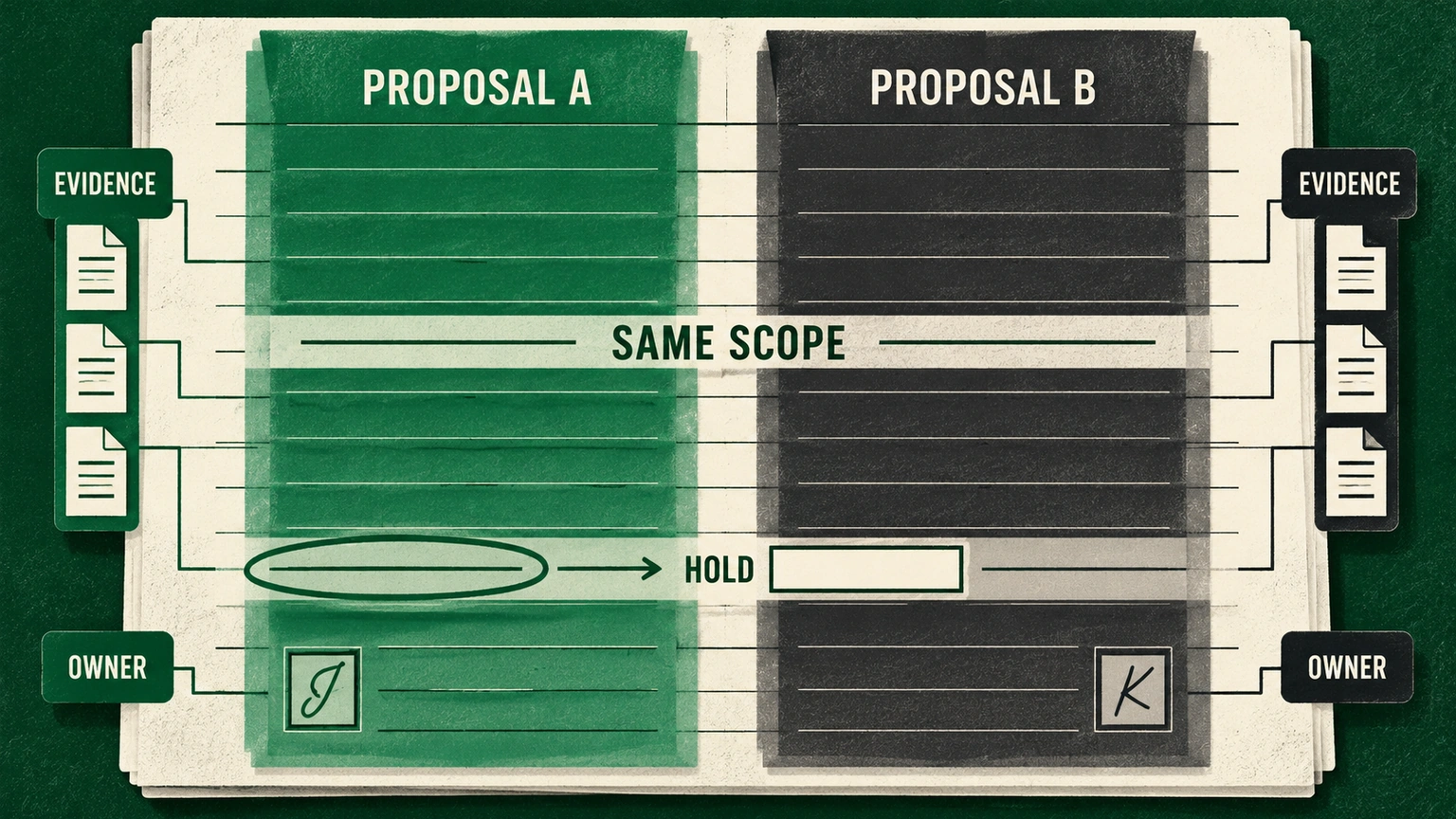
Choose an AI consultant for your CPA firm by asking shortlisted firms to quote the same workflow, then comparing the evidence behind each commitment. Make access, professional review, exception handling and ownership explicit before weighing price. A polished demonstration is useful, but it is not a comparable implementation proposal.
If you have two proposals that describe different jobs, you do not yet have a buying decision. You have a scope problem. One consultant may be quoting a draft generator; another may be quoting the integrations, review queue and ongoing support needed to use those drafts. Neither headline fee tells you which job the firm needs.
Bring one workflow and your unresolved proposal questions. Book a discovery call to examine the scope and the evidence needed for the decision.
What should every consultant quote on the same basis?
Write a shared scope statement before asking for a final price. For a CPA managing partner, CAS leader or COO, the useful unit is one operational handoff—not an open-ended promise to transform the practice.
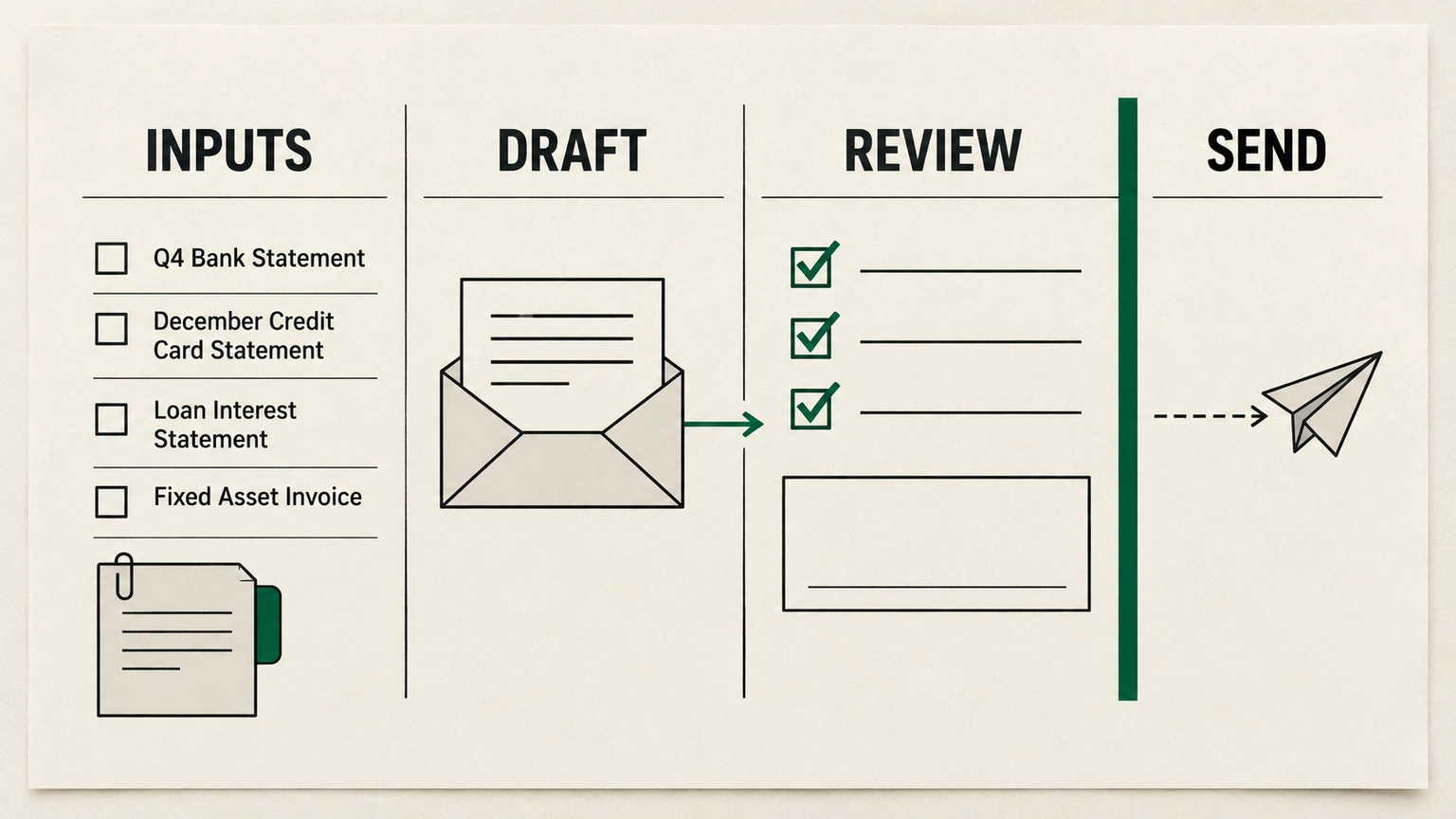
Take a sample project: prepare missing-document reminders from a firm-approved checklist and a client-status export. The workflow ends with a reviewer-approved reminder and an updated status record. It excludes tax advice, document interpretation and unattended client messages. The firm chooses the reviewer; the consultant specifies how the work reaches that reviewer and what happens when approval is missing.
Give each bidder the same input description, permitted systems, expected output and exclusions. Ask them to identify assumptions they cannot yet verify. If one requires a supported connector and another expects a custom integration, record that difference before comparing implementation fees. If the firm has not assigned a reviewer or determined permitted access, use the CPA AI readiness worksheet first.
Use the following scope card as the first page of your request:
- Workflow: what starts the work, and what marks it complete?
- Inputs: which records, systems and versions are in scope?
- Output: what must the reviewer receive, and where?
- Approval: who can approve the action, and what must wait?
- Exceptions: what happens with missing records, contradictory instructions or unavailable systems?
- Exclusions: what the consultant is not being asked to decide or automate.
- Acceptance: who will evaluate the result, using which agreed examples?
This is a procurement method, not a claim that a particular workflow will deliver savings. Agree the boundary before anyone promises a result.
How do you turn two proposals into a usable comparison?
Copy the worksheet below and require both bidders to answer every row. Keep the response, supporting evidence and unresolved question together. “Included” is not an evidence reference; a named deliverable, contract section or inspectable demonstration is.
Download the proposal-comparison worksheet. It contains blank response fields, not vendor ratings. Retain a dated version of each proposal alongside it so a revised answer does not silently replace the original commitment.
| Comparison row | Require from both proposals | Evidence to attach | Question that stays open until resolved |
|---|---|---|---|
| Workflow boundary and inputs | Same trigger, records, systems and finish line | Scope statement and input inventory | Are they quoting the same job? |
| Deliverables | Concrete outputs, integrations and documentation | Deliverable list and sample output | What must the firm build separately? |
| Evidence reference | A reference for each consequential claim | Demonstration record, document or contract clause | Can the firm inspect it before committing? |
| Excluded work | Explicit limits and dependencies | Exclusions and change-control terms | Who pays if an assumption is wrong? |
| Cost assumptions | Setup, recurring usage, support and firm effort | Itemized assumptions and pricing basis | Which costs vary with volume or review? |
| Named owner | Firm and consultant responsibility by handoff | Responsibility record with role and backup | Who owns an unattended queue? |
| Access and data handling | Required permissions, data destinations and retention | Data-flow explanation and permission plan | Which access or use is not yet approved? |
| Professional review | Actions that wait for a qualified reviewer | Review queue and approval record | Can the system proceed without approval? |
| Exception response | Missing input, duplicate work and unavailable system handling | Walkthrough of agreed exception cases | Who is notified and who can restart? |
| Monitoring and support | What is watched, response coverage and change ownership | Support scope and escalation route | What happens after the implementation ends? |
| Rights and handover | Deliverable rights, exports and transition obligations | Proposed terms and handover inventory | Can an accountable replacement continue? |
| Unresolved questions | Each gap, its owner and resolution condition | Dated decision log | What prevents acceptance today? |
For the sample reminder workflow, Proposal A might say “automated document chasing” while Proposal B says “draft reminders pending manager review.” Ask A whether the price includes the approval queue, evidence of approval and a way to stop duplicate reminders. Ask B whether writing the approved status back to the practice system is included. Do not score either response until both describe the same permitted action.
The questions are grounded in established due diligence, but the worksheet organizes them around a purchasing decision. CPA.com’s AI solution due-diligence guide asks accounting firms to examine data flows, access controls, validation, audit trails and export options. It is a framework for inquiry, not evidence that an individual provider meets those requirements.
For firms covered by the Safeguards Rule, the FTC’s business guidance calls for selecting appropriate service providers, spelling out security expectations in contracts, monitoring their work and periodically reassessing suitability. Determine applicability with the firm’s advisers. A completed worksheet is not a legal or compliance determination.
Questions for the reference call and the handover meeting
Use a reference conversation to check delivery habits, not to borrow another firm's results. Ask the consultant to arrange an authorized reference or provide an appropriately redacted example of the proposed deliverables. Do not ask for client records, confidential terms or material the reference is not permitted to share. If evidence cannot be supplied, keep that question unresolved rather than treating a confident answer as proof.
Ask the same questions of each shortlisted consultant:
- What was included at the start, and which assumptions later required a scope change?
- Who at the firm reviewed outputs, and what work remained with that person?
- How was an incorrect output or interrupted run reported, corrected and closed?
- What instructions, exports and operating records did the firm receive?
- Who could continue the work when the original builder was unavailable?
Record what the reference actually supports. Delivery on a drafting project does not establish competence for posting transactions, and a reference's time saving does not establish your firm's economics. Match the evidence to the workflow being commissioned.
Before signing, convert the proposal into a short handover checklist. Require a location and an acceptance owner for each item: workflow instructions, configuration inventory, access-revocation procedure, exception queue, support contacts and open dependencies. Specify which accounts the firm controls and how a replacement obtains authorized access without sharing someone's personal login. Have the firm's advisers review contractual rights rather than assuming that an export button grants ownership of every deliverable.
Take the missing-document reminder example. Ask a firm employee other than the builder to find a held draft, identify why it is held and locate the approved instructions for resuming it. Keep sending disabled during this check. If that person cannot continue safely, document the missing instruction and require a correction before accepting handover. This is an acceptance exercise to request, not a claim about a completed client engagement.
The practical buying question is whether the firm receives a usable operating process, not just a demonstration and a final invoice. Use the vendor exit handover guide for the detailed transition record and the pilot acceptance guide for the separate go-or-hold decision.
When should you hold a proposal instead of scoring it?
Hold the decision when a required control has no inspectable answer. Missing permission, an absent reviewer or unclear incident ownership is not a small weakness that a cheaper price should cancel out.
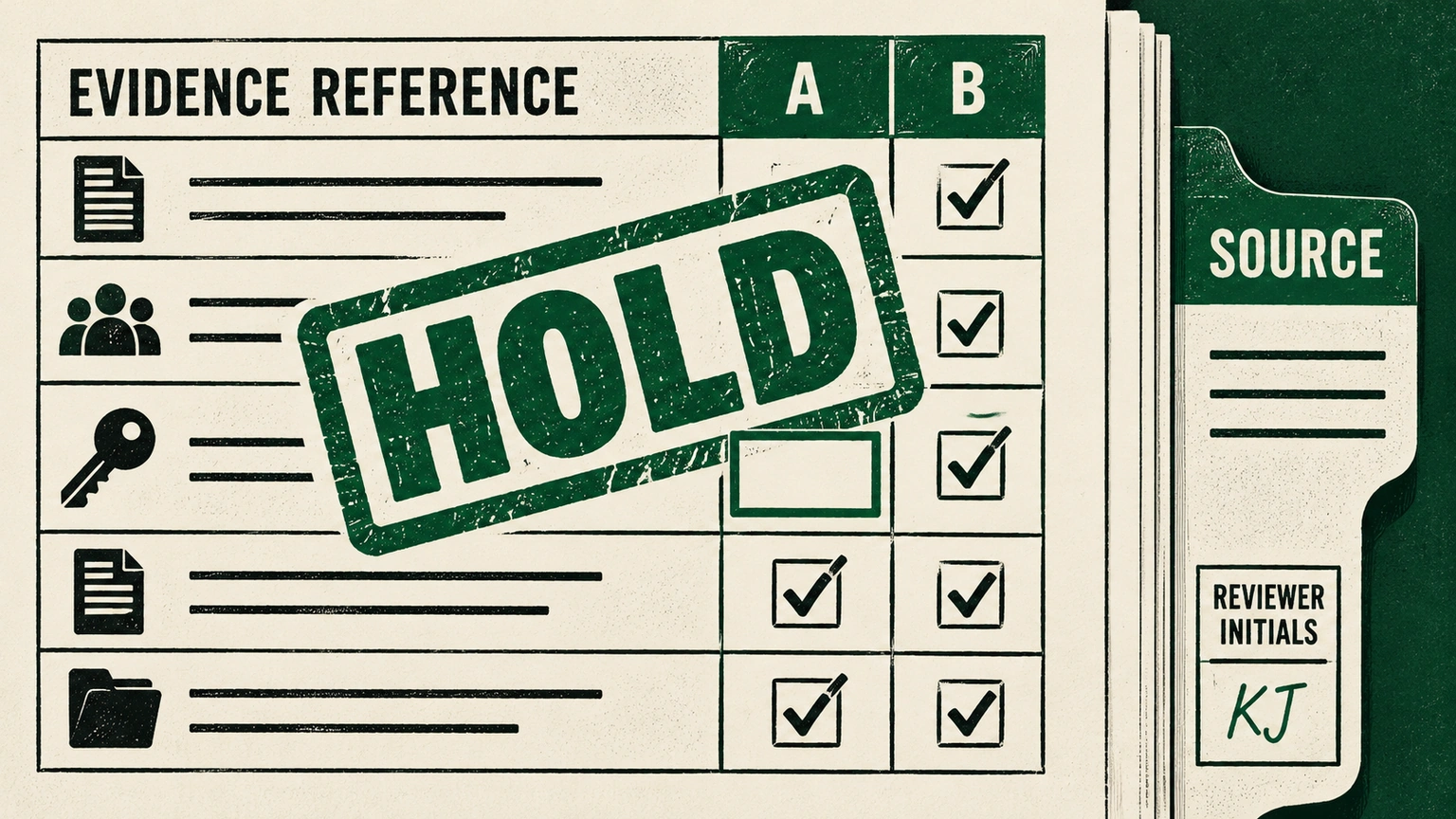
Use three states in the decision log:
- Comparable: both proposals cover the agreed boundary and required evidence is available. Compare delivery approach, cost assumptions and support commitments.
- Clarify: a response is ambiguous or an assumption differs. Name the question, responsible person and decision deadline; request a revised proposal.
- Hold: required access, review, evidence or ownership remains unresolved. No production approval follows from a good presentation or a strong aggregate score.
A demonstration should include a normal item and the agreed exceptions. Ask the consultant to show where a missing document goes, how a reviewer stops an action and what records remain when a system is unavailable. Use safe sample inputs first; do not upload client information before the firm has approved its handling. Define a separate pilot acceptance record rather than treating a sales demo as production acceptance.
Compare costs over the same scope and period. Include staff review and correction effort, implementation dependencies, recurring platform charges and support exclusions. Do not turn time saved into a promised cash saving without explaining whether capacity is redeployed or expenditure actually falls. The accounting AI review-cost model covers that economic question separately.
Ask what happens when the engagement ends, but do not make this worksheet a substitute for transition planning. Use the AI vendor exit handover register to examine the records, instructions and unfinished work a replacement needs.
Choose a consultant when the proposals are comparable, the required controls are evidenced, and the firm can own its side of the workflow. If nobody can name the reviewer or the system of record, pause procurement and resolve that first. If the firm wants a packaged product rather than a custom implementation, compare that option against the same boundary instead of assuming a consulting project is necessary.
Fixed Labs works on CPA firm workflow assessment and implementation. Bring one workflow, the proposals you are comparing and the questions nobody has answered. Book a discovery call to work through the scope and what evidence the buying decision needs.
For a billing-specific assignment, start with the CPA billing implementation scope ledger. It defines native setup, policy-dependent held-time selection and excluded historical migration before a provider’s proposal is normalized.
Compare the cost of an accepted output, not a model allowance
Ask each bidder to separate the platform subscription, metered model usage, integration maintenance and the firm’s review effort. Require an explicit assumption for retries and revised drafts: a proposal priced around one successful pass is not comparable to one that includes exception handling and support. Specify who sees usage overruns and who can pause spending. For document-heavy drafting, ask each consultant to show the usage assumptions behind the estimate and to keep them apart from any forecast of accounting savings; your accepted-output cost still needs measured review and correction effort. The AI implementation cost guide separates build, run and staff time for that comparison.
Put a first-year budget beside the proposals
Compare the same number of operating months and ask each bidder to mark which costs are bundled. A fixed implementation fee can still exclude data cleanup, new-system access, reviewer training or changes after launch. Separate external cash spend from internal staff time; neither should disappear because it sits outside the vendor invoice. Use the AI implementation cost breakdown and blank worksheet to document the one-time build, monthly operation and firm effort before choosing a provider. For delivery scope and operating responsibilities, see AI implementation services.
Frequently asked questions
How should a CPA firm choose an AI consultant?
Start with one defined workflow and ask shortlisted consultants to quote the same inputs, permitted actions, outputs and exclusions. Compare inspectable evidence for access, human review, exceptions and support before weighing cost. Keep unresolved questions in a decision log. A successful demonstration can inform the choice, but it does not establish that a complete implementation or its operating controls are included.
What should an AI implementation proposal include?
Require the workflow boundary, deliverables, dependencies, exclusions, cost assumptions, named owners, approval rules, exception handling, monitoring and handover rights. Attach an evidence reference to consequential commitments rather than accepting “included” as an answer. Ask both bidders to revise differences in scope before comparing fees. The proposal-comparison worksheet on this page provides blank fields for those answers; it does not rank actual providers.
Should the lowest-priced AI proposal win?
Not until the proposals cover the same permitted workflow and required controls have inspectable answers. A lower fee may exclude integrations, reviewer queues, monitoring or support that another bid includes. Compare the same period and include the firm’s review effort. Treat missing access approval or unclear incident ownership as a hold condition, not a weakness that a price discount can offset.
How can a CPA firm evaluate a consultant without sharing client data?
Begin with firm-approved sample inputs and agreed normal and exception cases. Ask the consultant to show the output, approval boundary and escalation record. Before a trial uses client information, resolve permitted access, data destinations, retention and contractual responsibilities. CPA.com’s due-diligence guide recommends examining those questions and validating behavior; the firm still needs to determine its own professional and legal obligations.
Who implements AI workflows for CPA firms?
Fixed Labs offers workflow assessment and implementation for CPA and accounting firms, including document collection, bookkeeping and close-review workflows. The firm’s professionals retain judgment and approval responsibilities. Start at fixedlabs.ai/contact with one workflow and the questions your buying decision needs answered. Specific systems, scope, controls and support commitments must be agreed for the engagement; this article does not promise a particular integration or result.