Best AI Automation Agencies for US Businesses (2026)
Pick an AI automation agency that will still own the workflow a year after launch. Among US providers, compare Fixed Labs for recurring back-office work, Xcelacore when custom software or ERP integration is part of the job, HatchWorks AI when data and adoption work come first, and V-Soft Consulting for ServiceNow or Salesforce-heavy operations.
Book a discovery call
Pick an AI automation agency that will still own the workflow a year after launch. Among US providers, compare Fixed Labs for recurring back-office work, Xcelacore when custom software or ERP integration is part of the job, HatchWorks AI when data and adoption work come first, and V-Soft Consulting for ServiceNow or Salesforce-heavy operations.
This guide is for the owner, COO or CFO of an established business doing $5M+ in revenue who wants back-office work automated and someone to keep it running. Fixed Labs is our firm and it is on this list, so weigh our section accordingly. Everything said about the other three comes from their own websites, checked on October 27, 2026.
How an automation agency differs from an AI consulting firm
An AI consulting firm sells judgment. It tells you which processes are worth automating, in what order, what can go wrong and how to bring your people along. What you get at the end is usually a plan.
An AI automation agency sells a working process. It builds one specific workflow inside the software you already run, such as invoice drafts from approved time or intake from a shared inbox. The good ones stay on afterwards to watch it, fix it when a run fails and change it when your systems or rules change.
Plenty of firms do some of both, so the label on the website tells you little. Read the proposal. If it ends with a roadmap, you are buying consulting. If it ends with a workflow in production and a named person who answers when it breaks, you are buying automation.
Which one you need depends on how well you already know the problem. If leadership is asking what the company should do with AI and nobody can point to the work that eats the hours, start with a consulting firm; our comparison of AI consulting firms covers that side. If you can already say "our billing team spends every month-end re-keying time entries into invoices," a strategy engagement is a detour. Hire someone to build it.
You may not need either. For a single app-to-app handoff with fixed rules, Zapier, Make, n8n or Power Automate will do the job, and your team can own it. An agency earns its fee when the inputs are messy (emails, PDFs, scans), the systems don't talk to each other, or someone has to own the approvals and the monitoring.
Four AI automation agencies compared
| Agency | Hire them when | What their site says they do | Get in writing |
|---|---|---|---|
| Fixed Labs | Recurring back-office work crosses several systems and nobody inside has time to maintain automations | Picks the workflows with you, builds in your existing software, monitors and fixes them monthly after launch | Who on your side approves outputs, what system access is needed, support hours |
| Xcelacore | The automation also needs custom software, ERP or CRM work, or an existing RPA bot | AI and machine learning, custom software, RPA, cloud development, Salesforce, Dynamics 365 and NetSuite work | Who watches the AI workflow after go-live, and whether that is in the monthly budget |
| HatchWorks AI | Data cleanup and adoption across several teams have to happen before automation pays off | AI strategy, agentic automation, data modernization, change management, embedded engineers | The smallest engagement they take, and what must happen before the first live workflow |
| V-Soft Consulting | The workflow lives inside a larger ServiceNow, Salesforce or managed IT program | AI and process intelligence, enterprise integrations, ServiceNow, Salesforce, managed IT, tech staffing | Which team owns the workflow logic, as opposed to the platform underneath it |
None of the four publishes a price on the pages we checked, so any cost comparison starts with proposals.
Fixed Labs: recurring back-office work, run after launch
We build automations and AI agents for work that repeats every week and follows rules someone can write down: invoice drafts from approved time, payment matching, client intake, weekly reports pulled from several systems, and the re-keying between email, spreadsheets and portals. We build in the software you already use, often on the Zapier, Make, n8n or Power Automate account you already pay for, and add AI where fixed rules break down. A person approves any step that reaches a client or moves money.
A first workflow usually reaches production in three to six weeks. System access and how settled your rules are set the pace. After launch we monitor every run, fix failures and review the results with you each month. We quote the build and the monthly running separately, after a discovery call.
Most of the work is learning what correct looks like. For one accounting firm we spent two weeks with the invoicing team writing down its billing rules and exceptions before building anything. Over the next three weeks the workflow prepared 513 invoices at about six minutes each, against the team's own estimate of 15 minutes by hand, and staff still approved every invoice before it went out. More on that kind of work is on our page for accounting and CPA firms.
You supply a process owner who can show us what a correct invoice, intake or report looks like. We're the wrong hire for one simple connection your team could set up in an afternoon.
Xcelacore: when the software around the AI is the hard part
Xcelacore describes itself as a Chicago-based technology consulting firm. Its site lists AI and machine learning alongside custom software, RPA, cloud development on Azure and AWS, and ERP and CRM work on Salesforce, Microsoft Dynamics 365 and NetSuite, plus integrations with payment systems.
That mix fits a job where the AI step is small and the integration is big: an RPA bot that keeps breaking, or a NetSuite customization the workflow depends on. Ask for examples on your exact system and version. The homepage doesn't describe an ongoing operating service for AI workflows, so ask who watches the workflow after go-live, who changes it when your rules change, and what that costs each month.
HatchWorks AI: when the data and the people come first
HatchWorks AI covers AI strategy, AI-driven development and AI change management, with agentic automation and data modernization among its deliverables. You can buy forward-deployed engineers embedded in your teams, a cross-functional "Agentic AI Pod", or an end-to-end transformation program. It describes US and nearshore engineering talent and lists offices in Atlanta, Chicago and Dallas, plus Costa Rica, Colombia and Peru.
Look at HatchWorks when your workflow can't work until the data is cleaned up or several departments change how they operate. That is a bigger purchase than automating one process. Ask what the smallest engagement is, what has to happen before the first workflow goes live, and how much of your staff's time it takes.
V-Soft Consulting: when the workflow sits inside a platform program
V-Soft Consulting spans AI and process intelligence, enterprise integrations, ServiceNow, Salesforce, application engineering, managed IT and specialized tech staffing. It lists offices in ten cities, starting with Louisville, Kentucky.
Those are separate purchases even when one firm sells them all. V-Soft is a fair comparison when the automation has to live inside a ServiceNow or Salesforce program you already run. Insist on one named owner for the workflow itself: the logic, the access, the incidents and the staff approvals. A team that monitors servers can't tell you whether an AI-prepared document is right.
Give all four the same workflow to quote
Four demos are hard to compare. Four quotes on the same job are easy. Pick one recurring process and describe it the same way to everyone. For example: prepare invoice drafts from approved time, the billing rules and client records, then hand each draft to a named reviewer. The automation never sends an invoice or marks it approved.
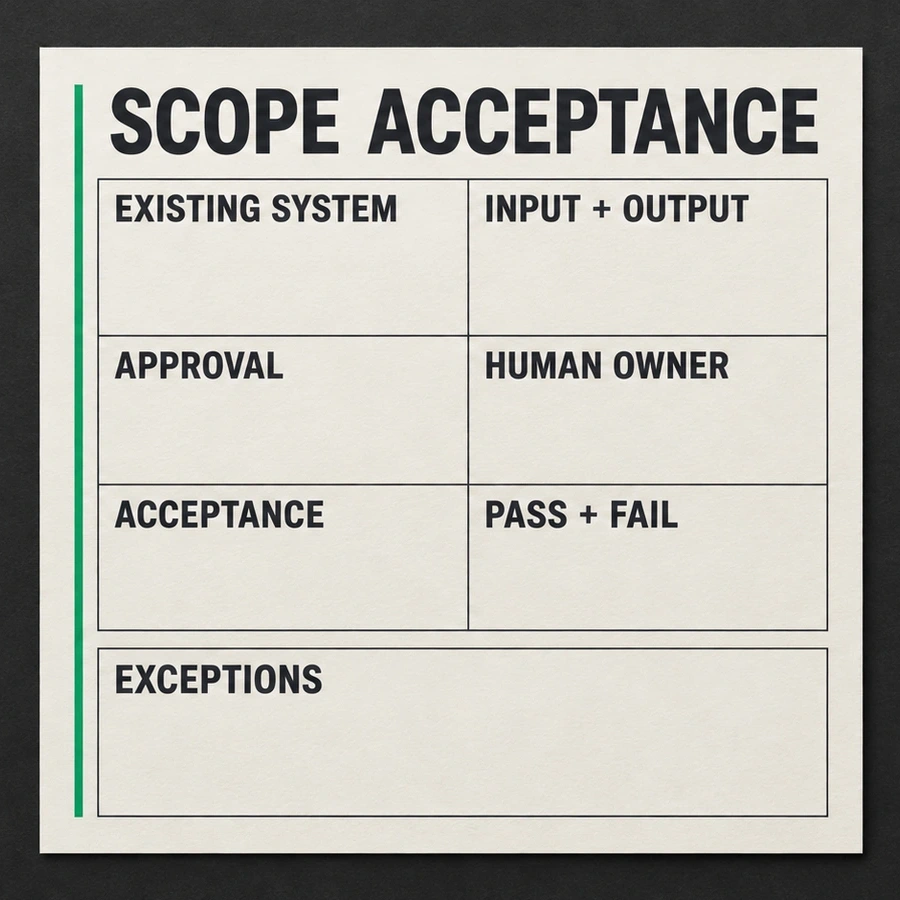
Put these in the request and judge the answers:
| What to tell them | What a good answer covers |
|---|---|
| Where the work arrives, and normal and peak volume | Which source they connect to and what changes at peak |
| What a correct output looks like, with real examples | Which cases they will hand back to your staff |
| Who approves, and what must never run on its own | A named reviewer and a hard stop before anything is sent or posted |
| The messy cases: missing data, conflicting rules, duplicates | A test run on those same cases before going live |
| What happens when a run fails or a login expires | How they find out, who they tell, and how they restart without doing the work twice |
| Who runs it after launch | Support hours, the monthly fee, what's excluded, and what you keep if you leave |
This is how you stop a cheap build-only bid from looking like the same thing as a monitored service.
Questions to ask on the first call
- Which of our processes would you advise us not to automate, and why?
- Who approves the sensitive steps, and how does the workflow stop before them?
- A run fails at 2 a.m. Who finds out, and when?
- When our software updates or our billing rules change, who changes the automation, and is that in the monthly fee?
- How will we know it worked? Look for a baseline taken before launch (hours a week, turnaround, backlog or error rate) and the same numbers reported every month after.
- If we end the contract, what do we keep: documentation, access, the build itself?
Vague answers to the third and fourth questions are the clearest warning sign. A demo shows the good day. The contract has to cover the bad one.
What the quote should cover after launch
Ask for the build and the running priced separately. The build delivers the agreed workflow. The monthly fee should buy named things: monitoring, incident handling, changes up to an agreed size and a monthly review. Neither number should hide software subscriptions, AI usage charges, your staff's review time or work outside support hours.
If your own team will maintain it, price the handover: documentation, who owns the accounts and access, training and a few weeks of overlap. A line that says "ongoing support" with no hours, exclusions or named team behind it isn't ready to sign.
Where to start
Bring one recurring process to a call, with the systems it touches and the exceptions your staff handle by hand today. We'll tell you whether it's worth automating, whether we're the right fit or one of the others is, and what the first workflow would look like. Book a discovery call.
If you are buying across several portfolio companies, see our AI consultants for private equity. Law firms should start with AI consultants for law firms, and accounting firms with AI consultants for accountants.
For the implementation that follows an acquisition, compare AI agencies for US private equity by readiness, delivery scope and continuing responsibility.
Frequently asked questions
What is the best AI automation agency for a US business?
It depends on the work and who will run it afterwards. Fixed Labs fits recurring back-office work across existing systems, Xcelacore fits jobs heavy on custom software or ERP integration, HatchWorks AI fits projects where data and adoption come first, and V-Soft Consulting fits ServiceNow or Salesforce programs. Give each the same workflow to quote and ask who owns it after launch.
What is the difference between an AI automation agency and an AI consulting firm?
A consulting firm tells you what to automate and in what order, and usually delivers a plan. An automation agency builds a specific workflow in your systems and, if it is a good one, keeps it running after launch. Many firms do both, so judge by what the proposal delivers: a roadmap, or a live workflow with a named owner.
How much does an AI automation agency cost?
None of the four agencies in this guide publishes a price on the pages we checked, so you compare proposals. Ask for the build and the monthly running priced separately, and for a list of what is excluded, such as software subscriptions, AI usage charges and your own staff's review time. Fixed Labs quotes both after a discovery call.
How long does it take an agency to automate a workflow?
At Fixed Labs a first workflow usually reaches production in three to six weeks. Roughly, the first week is discovery, the next few weeks are building and testing on real cases, and the workflow then runs on live work with a person approving outputs. System access and how settled your rules are set the pace.
Do we need an AI automation agency, or can we use Zapier or Power Automate ourselves?
For a simple app-to-app handoff with fixed rules, Zapier, Make, n8n or Power Automate are usually enough and your team can own them. An agency earns its fee when inputs are messy, such as emails, PDFs and scans, when systems don't integrate, or when someone has to own approvals and monitoring after launch.