Best AI Consultants for Accountants (2026)
Choose an accounting AI consultant by the responsibility you need: training, a working build or ongoing operation. Shortlist Fixed Labs for recurring practice workflows, Charlie Barmore for practitioner-led implementation, SmartFirm for adoption and stack advice, Two Factor for IT-coordinated delivery, and Phos AI Labs for broader governed builds.
Book a discovery call
Choose an accounting AI consultant by the responsibility you need: training, a working build or ongoing operation. Shortlist Fixed Labs for recurring practice workflows, Charlie Barmore for practitioner-led implementation, SmartFirm for adoption and stack advice, Two Factor for IT-coordinated delivery, and Phos AI Labs for broader governed builds.
For managing partners and COOs of established businesses doing $5M+ in revenue, the important difference is who owns the work after the demonstration. A staff workshop, a configured workflow and a monitored service solve different problems. This guide compares accounting-practice operations, not outsourced accounting or tax advice.
Five accounting AI consultants to shortlist
Start with the delivery model, then verify the integration and reviewer. Fixed Labs is our firm. Compare the providers below on the work they commit to deliver and the responsibilities your team keeps.
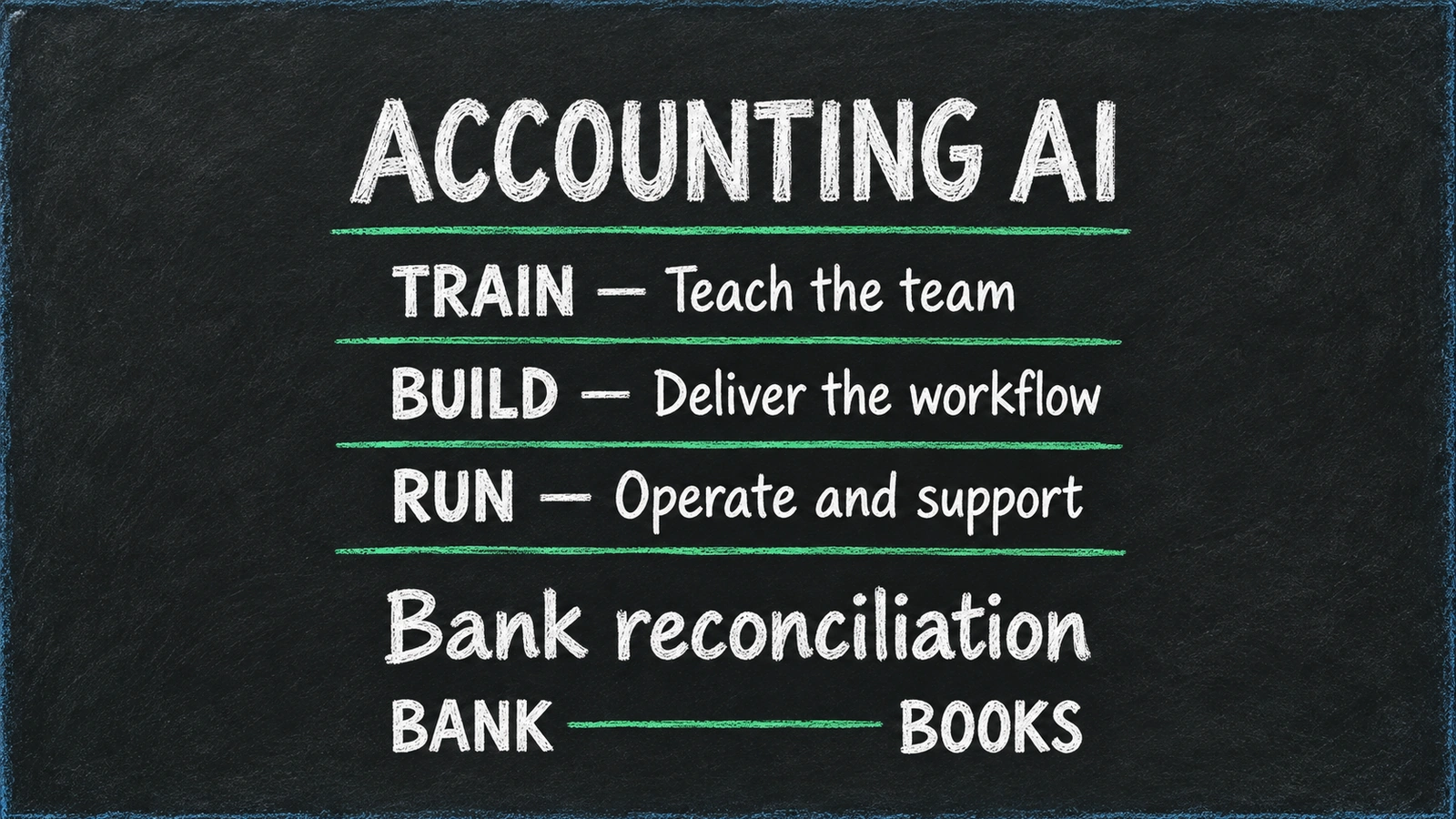
Dated comparison: what each provider publishes
Sources checked October 26, 2026. “Confirm” means the opened page does not establish the exact commitment for your engagement. An ongoing partner option is not automatically a response-time agreement.
| Provider and primary source | Accounting work and delivery model | Systems and review | Commercial shape and run responsibility |
|---|---|---|---|
| Fixed Labs | Invoice preparation, WIP follow-up, payment matching and onboarding; build and monthly operation | Existing practice systems; people approve client-facing and money-moving actions | Fixed build plus monthly run fee, quoted after discovery; monitoring, fixes and updates included in monthly scope |
| Charlie Barmore, CPA | Readiness assessment, team playbook and a scoped bottleneck build | Claude-centered playbook; practitioner retains judgment; confirm exact connectors and backup coverage | Working sessions $500/hour; assessment and implementation fixed fees scoped to the firm; optional month-to-month ongoing partner |
| SmartFirm AI training and technology advisory | Two or three co-built uses and role-based training; separate stack assessment and implementation | Confidentiality and review rules; technology advisory covers native, middleware and custom API connections | Fixed-scope AI program with handoff; optional fractional AI partner; numeric fees and default AI operating coverage not stated |
| Two Factor | File organization, missing-information drafts and recurring handoffs; choose, connect, test and train | Approved systems and permissions; staff check outputs; connections depend on licensing and vendor restrictions | Deliverables, timeline and fees defined before work; ongoing support and improvements scoped with the buyer |
| Phos AI Labs | Reconciliation, document collection, invoice review and research preparation; audit, build and embedded support | Describes governed access and review; qualified accountants retain filings, positions and advice | Phased engagement; confirm a current quote, supported accounting systems and post-launch coverage |
Fixed Labs: recurring practice operations with monthly ownership
Fixed Labs fits a firm that wants one recurring workflow built in its existing systems and kept running. Our accounting-firm implementation service starts with billing rules, access and a sponsoring reviewer. The published first-workflow range is three to six weeks, depending on access and how settled the rules are.
The tradeoff is commitment on both sides: the firm must supply its rules and reviewer, and the build and monthly operation need a scoped quote. We do not publish a dollar price. This is not the same purchase as a standalone class or an assistant subscription. Ask us to identify the monthly exception owner, the support boundary and the work your staff still perform.
Charlie Barmore, CPA: a practitioner-led first build
Barmore's accounting-firm page describes a two-to-three-week readiness assessment and a four-to-eight-week implementation. The implementation combines a shared Claude playbook with a specific bottleneck build, tested and handed off. A month-to-month ongoing partner option adds refinements and training.
This is worth considering when a firm wants a direct working relationship with a practicing CPA. The public offering is individual-led; the page does not establish multi-person backup or response coverage for a large platform rollout. Ask who can maintain the workflow if the original builder is unavailable, and verify integration permissions rather than treating the playbook as a connector guarantee.
SmartFirm: staff adoption and accounting-stack decisions
SmartFirm's AI program selects two or three real use cases, co-builds them with staff and leaves confidentiality rules, review discipline, prompts and SOPs. Its separate technology advisory covers stack assessment, software selection, implementation and integration architecture.
That distinction matters. The AI training program is a defined engagement intended to leave capability inside the firm, not an open-ended reengineering project. Broader technology support is available, but do not assume it is bundled with the training. Ask which use becomes a supported integration, which systems can read or write the required fields, and whether the firm or SmartFirm owns the daily queue after handoff.
Two Factor: coordinate the workflow with IT
Two Factor describes hands-on AI implementation for accounting firms and other professional services. Its process selects a workflow, configures approved information and systems, tests scenarios and exceptions, and documents review and ownership. Its accounting examples include organizing files, drafting missing-information requests and preparing task handoffs.
This is a useful fit to investigate when AI delivery must align with existing IT responsibilities. It is a multi-industry IT provider, not a CPA-only consultancy. The page does not promise a particular accounting connector, numeric project fee or default support response time. Ask how the AI statement of work relates to managed IT, and who owns a failed run outside normal working hours.
Phos AI Labs: a broader governed workflow program
Phos describes accounting builds across reconciliation, document collection, invoice review, tax-research drafting and audit preparation. Its offering moves from an AI readiness audit to workflow builds and embedded implementation. It describes access controls and review, with qualified accountants retaining responsibility for filings, financial statements, tax positions and advice.
Consider it when the scope spans preparation workflows and governance rather than one training session. The breadth also makes scoping important: ask which workflow launches first, what the firm receives at each phase, and who maintains it after launch. Vendor descriptions of governance are not an independent security audit; verify actual data destinations, retention terms and accounting-stack access with your IT lead and advisers.
For a broader, cross-industry search, use the mid-market AI consulting shortlist. For this accounting-specific choice, take only providers that can explain the same workflow and its owner into the next round.
Give every shortlisted firm the same workflow brief
Ask each consultant to quote invoice preparation with the same input, approval and exception boundaries. This makes the proposal comparable without assuming every provider should build a custom system.
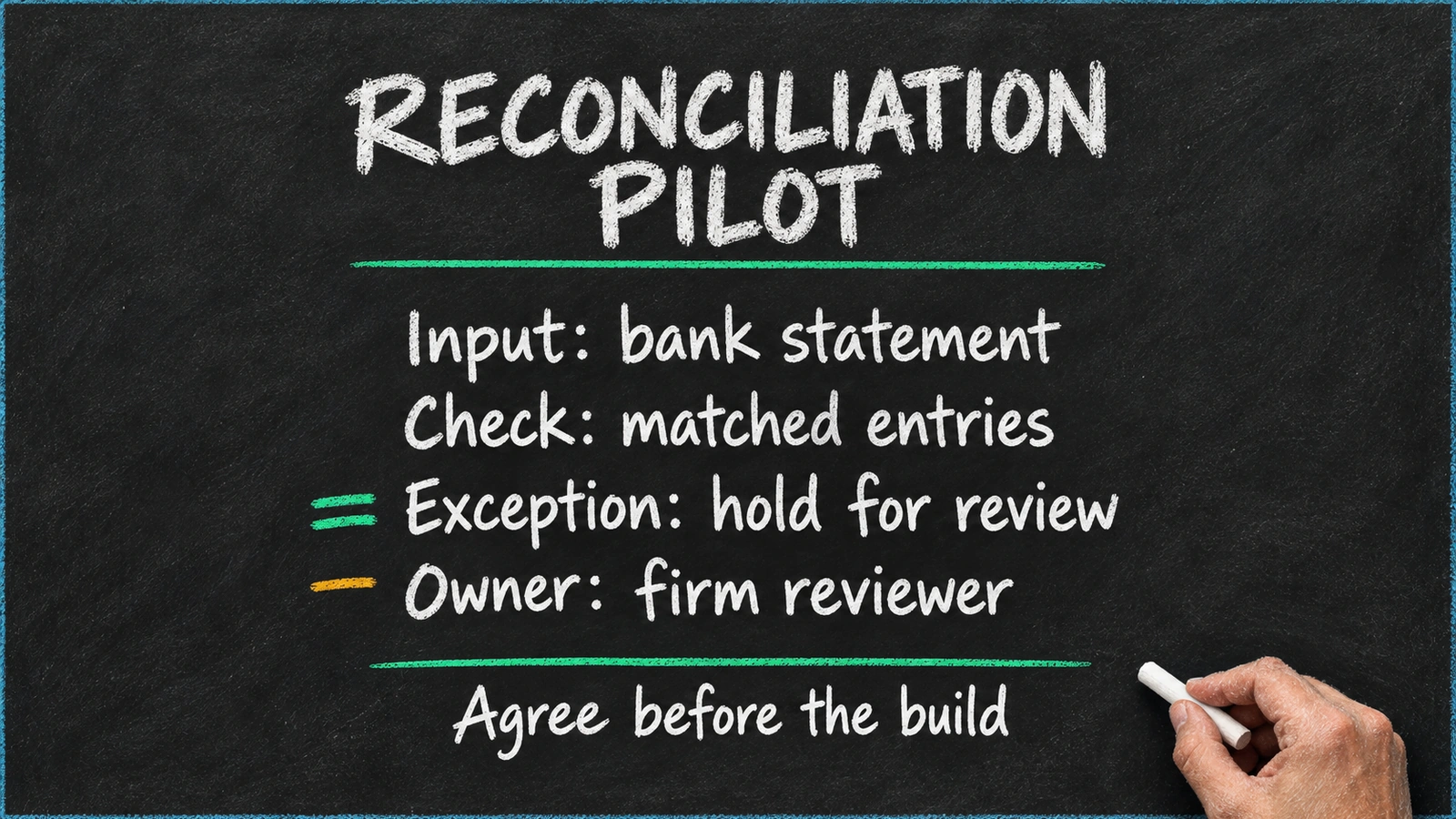
The published Fixed Labs billing observation describes two weeks documenting a firm's rules, then 513 invoices across three observed weeks at about six minutes each, against the team's estimated 15-minute manual baseline. Staff still approved every invoice. Preparation and review time will depend on your own rules, systems and exception volume.
The buying lesson is to price the rules and review work, not just invoice generation. The image uses reconciliation to show the same input/check/exception/owner structure; the brief below applies it specifically to billing. Copy it into your request and replace the blanks with your own approved process.
| Brief field | Same assignment for every bidder | Evidence to request |
|---|---|---|
| Workflow | Draft invoices for one agreed billing period from approved time and engagement terms | Source inventory, trigger and sample draft |
| Native fit first | Check whether existing software configuration handles the task before proposing a custom build | Demonstration of supported native behavior and the remaining gap |
| Rules | Apply the firm's written fee, time-selection and hold rules; do not invent missing policy | Rule list with a firm approval owner |
| Review | Billing manager or partner approves each invoice before sending | Held draft, reviewer queue and approval record |
| Exceptions | Hold missing terms, disputed time, duplicates and unavailable source data | Walkthrough of each agreed exception and its recovery owner |
| Exclusions | No unattended sending, policy changes or historical balance migration unless separately approved | Explicit exclusions and change-control terms |
| Acceptance | Firm reviewer checks normal and exception samples against agreed expected outputs | Signed decision, unresolved items and a stop procedure |
| Measurement | Measure preparation, review and correction time separately on the same work | Measured baseline and pilot record, not a borrowed saving |
| Operation | Name primary and backup owners for queues, failures and software changes | Support scope, coverage hours and handover instructions |
A bidder can reasonably recommend training, native setup or a custom build. What matters is whether the proposed approach covers this boundary. If the required data cannot be accessed or the rules remain disputed, hold the build rather than accepting a confident delivery date. Use the CPA consultant proposal guide to turn the responses into a like-for-like decision.
Compare budget and post-launch responsibility
Choose the provider only after the proposal includes build costs, ongoing operation and your firm's staff time. A lower external fee is not necessarily a lower-cost operating process if it leaves integrations, review or failure recovery with people who have no capacity to own them.
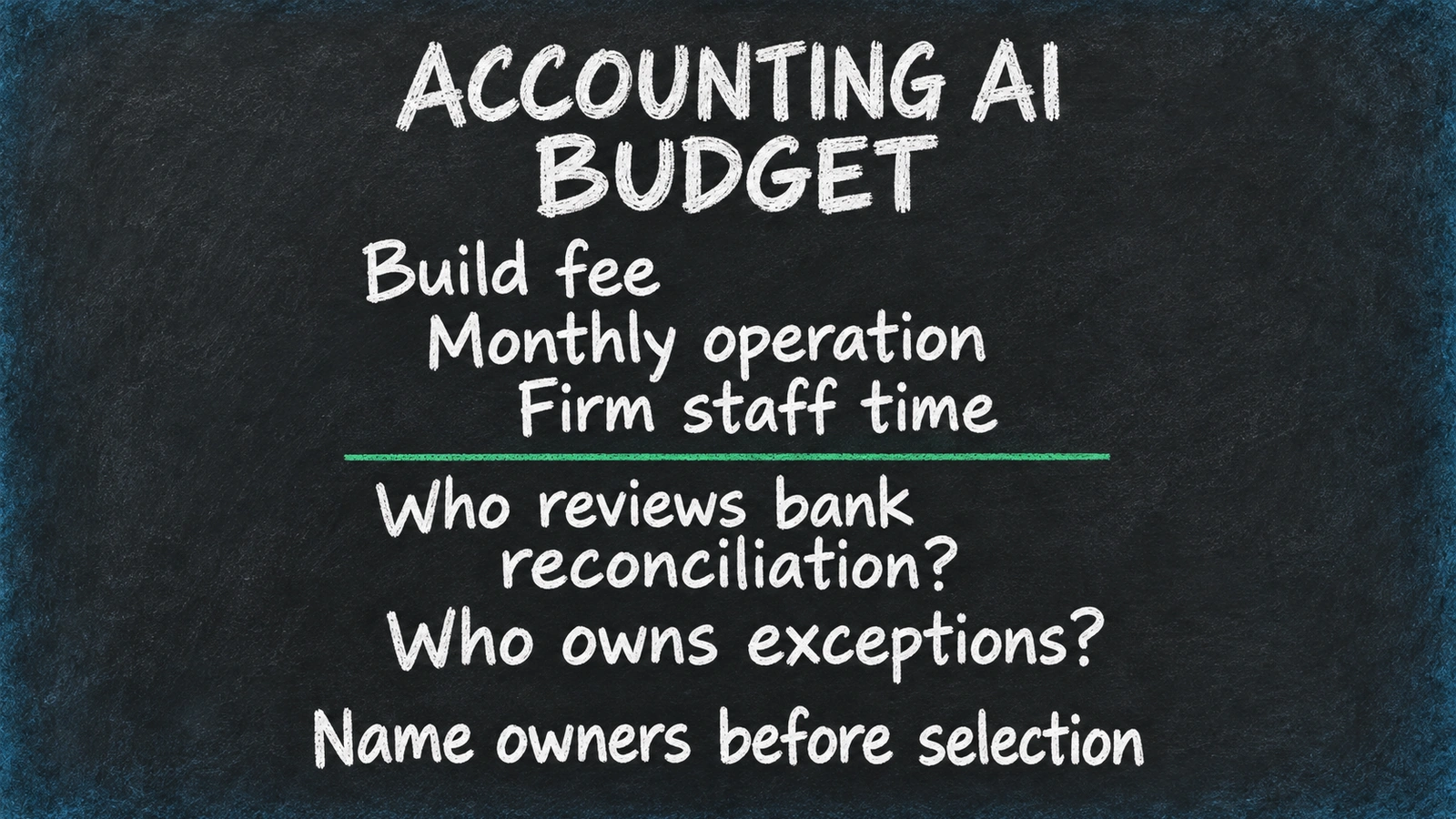
Use these questions in the final conversation:
- Train: Which staff roles learn the work, what reusable instructions remain, and who checks that staff can continue without the trainer?
- Build: Which systems and fields are included, who supplies access, and what normal and exception cases must pass before acceptance?
- Run: Who watches the queue, fixes an interrupted run and approves changes when the practice software updates? What coverage is excluded?
- Cost: Which fees are one-time, monthly or usage-dependent? Which work remains with your reviewer and IT lead?
- Exit: What records, configuration and instructions transfer, and can a named backup continue safely?
Treat a workshop as a workshop and a supported production workflow as a supported production workflow. Both can be useful; buying one while expecting the other is the avoidable mistake. The AI implementation cost guide separates the budget categories without treating released capacity as automatic cash savings.
If you need ongoing operation, a provider that only hands off may still fit when your firm has a capable internal owner. If you have no such owner, make monthly coverage explicit before signing. Conversely, paying for a managed service may be unnecessary when your team only needs a bounded adoption program.
Fixed Labs provides AI consulting and implementation for established businesses doing $5M+ in revenue, accounting firms first. Bring one workflow, your current systems and the responsibility you need help carrying. Book a discovery call to work through the scope and what should remain with your people.
Frequently asked questions
Who are the best AI consultants for accounting firms?
Choose by responsibility rather than a universal ranking: staff adoption, a defined workflow build or ongoing operation. Compare accounting-specific providers on the same workflow, systems, human review and support boundary. Ask for evidence of the exact integration and exception path before signing. A provider can fit a training assignment without being the right choice to operate a production workflow.
Should an accounting firm buy AI training or implementation?
Buy training when staff need skills and can own the resulting work. Buy implementation when the missing piece is a configured workflow, integration or review queue. Add ongoing operation when nobody inside the firm can maintain the process reliably. These are separate commitments, even when one supplier offers all three. Ask the proposal to name the deliverables and owner for each.
How much does accounting AI consulting cost?
There is no like-for-like fee until the workflow is defined. Charlie Barmore publishes working sessions at $500 per hour, while larger assessment and implementation assignments are scoped separately. Other offers combine fixed projects, training or recurring operation. Compare the same deliverables and period, including software usage and your staff review time; an hourly session is not a benchmark for a supported production build.
What should an accounting firm check before giving a consultant client data?
Resolve which records can be used, where they go, who can access them, how long they remain and who can approve consequential actions. Ask for the proposed data flow and contract terms, and have your IT lead and professional advisers review them. Begin demonstrations with firm-approved sample data. A vendor statement about governance does not replace diligence on the actual workflow.
Who can build and run AI workflows for a CPA firm?
Fixed Labs builds recurring accounting workflows and runs them monthly, with people retaining professional judgment and approval of client-facing or money-moving actions. Start at fixedlabs.ai/contact with one workflow and the systems involved. Exact access, deliverables, reviewer responsibilities and support coverage must be agreed for your engagement. A discovery call can establish the scope; it does not promise an integration or a result.