Fractional CAIO vs AI Consultant: Which Fits?
Book a discovery call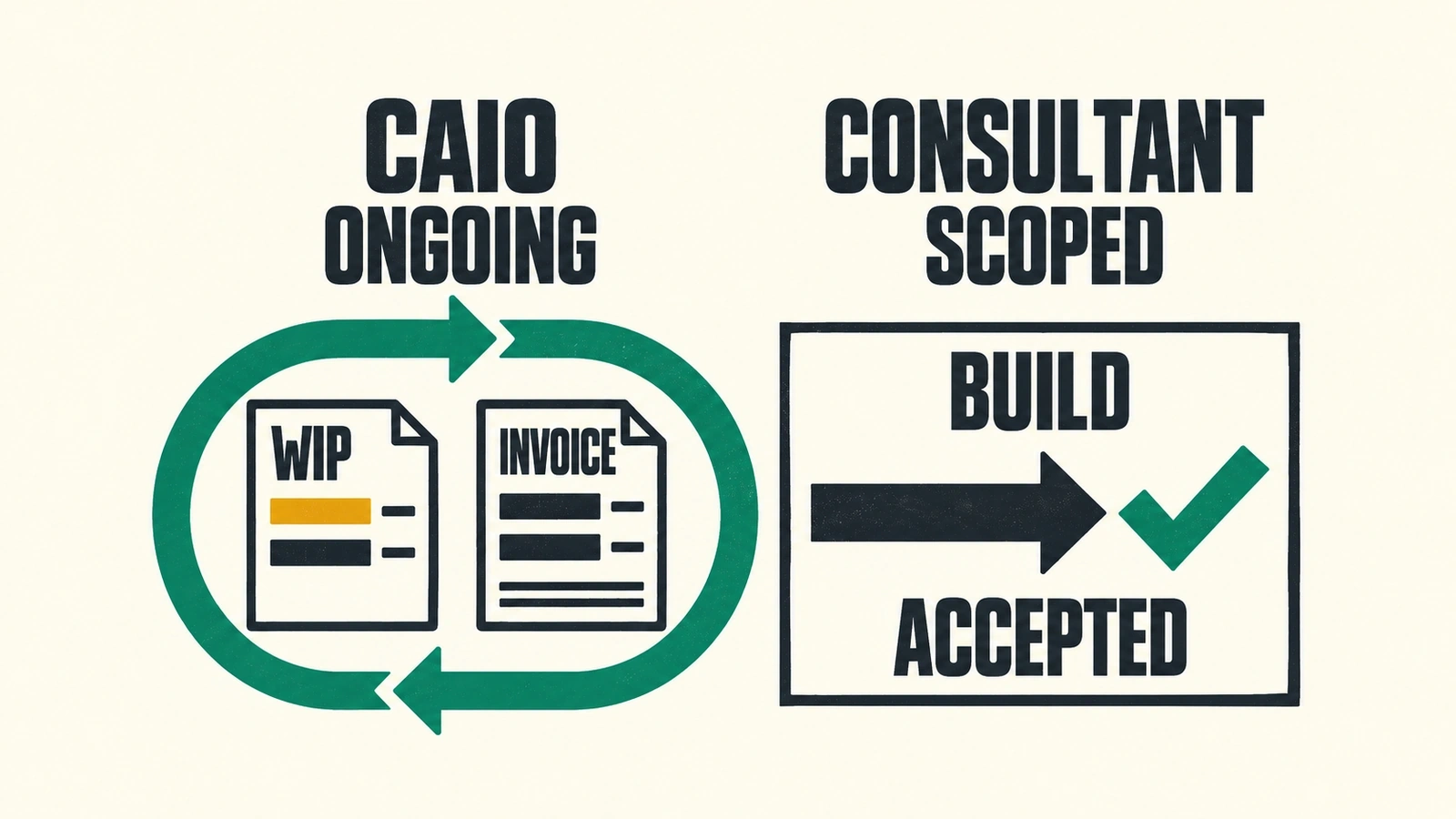
Choose a fractional CAIO when your firm needs someone to keep ranking AI priorities, coordinating owners and reviewing results across projects. Choose an AI consultant when you can define the question or deliverable and name the person who will own what follows; either provider may also build and support systems if contracted to do so.
For a managing partner or COO at an accounting firm, the difference is the job left unfilled. Is nobody deciding whether billing, onboarding or document collection comes next? Or has leadership already chosen invoice preparation and needs someone to deliver it? Established businesses doing $5M+ in revenue can face either situation. Revenue alone does not settle the choice.
- Buy recurring leadership when priorities and tradeoffs need continuing attention.
- Buy a scoped engagement when the output, acceptance owner and next step are clear.
- Ask separately who builds, who maintains and who can authorize changes.
Fixed Labs offers both AI consulting and a fractional chief AI officer with a delivery team. Bring the unresolved decision to a discovery call; the useful starting point is the responsibility you need covered.
What changes between a fractional CAIO and an AI consultant?
A fractional chief AI officer is a part-time leader responsible for an agreed AI agenda. A scoped AI consultant is responsible for a defined assignment, which can include research, a recommendation, training or a working system. The distinction is continuing responsibility for priorities versus responsibility for a specified output.
The roles overlap. A consultant can stay on a retainer, and a fractional leader can work alongside a separate builder. Neither a retainer nor an executive title tells you what is included. Define the mandate, available time, delivery team and decision rights in writing.
This comparison is our buying guide as of October 25, 2026. It describes engagement shapes, not measured performance or universal provider terms.
| Decision | Fractional CAIO engagement | Scoped AI consulting engagement |
|---|---|---|
| Main need | Recurring AI priorities need a senior owner | One decision or deliverable needs specialist work |
| What you commission | A continuing mandate, review cadence and agreed outcomes | Defined outputs, acceptance criteria and a completion point |
| Example at a CPA firm | Rank billing, onboarding and document collection against staff capacity | Deliver an invoice-preparation workflow with agreed review steps |
| Who builds | Named internal or provider team; confirm whether included | Consultant, their team or a separate builder, as scoped |
| After delivery | Continue reviewing priorities and results within the mandate | Handover, support or further work under the agreed terms |
| Decision authority | Only authority expressly assigned by the firm | Only authority expressly assigned by the firm |
| Main limitation | Part-time availability can constrain urgent or daily leadership | A finished project does not fill an unassigned firm-wide leadership role |
| Fair cost comparison | Leadership time, delivery capacity, operation and firm effort | Project work, follow-on operation, changes and firm effort |
The public descriptions vary. James Killick includes building in consulting and warns that the titles overlap. Paul Okhrem defines fractional ownership within agreed authority and hours. Those are useful reasons to read the proposal before choosing the label.
When consulting is enough
Start with a scoped consultant when you can state the output and identify someone inside the firm who can make the necessary decisions. “Determine whether our current billing software can prepare this invoice type” is a bounded question. “Build the approved draft-preparation workflow and train its operator” is a bounded delivery assignment.
Consulting can also help define an unclear problem. You do not need to buy a continuing executive role merely because the first question is broad. Commission a useful diagnostic with a decision at the end: proceed with one project, assign an internal owner, or retain ongoing leadership.
When recurring leadership earns its place
Consider a fractional CAIO when decisions keep arriving across teams and no existing leader has the time or expertise to resolve them consistently. Billing wants faster drafts, onboarding wants new automation and IT needs a decision about shared access. Someone must weigh the competing demands, bring choices to the sponsor and revisit the order when evidence changes.
Ask how much time that person will actually spend with your firm and who covers urgent issues. If the role requires daily management of a permanent team, compare a full-time leadership hire. If your COO already handles the priorities well, additional implementation capacity may be the missing piece. Our partner versus in-house hire guide addresses that separate staffing decision.
Use one billing problem to test the scope
A CPA firm should distinguish an unresolved billing rule from an unresolved AI priority. A leader can decide that invoice preparation deserves investment. The firm's authorized billing owner still decides which time is billable, how exceptions are treated and who approves invoices.
Our published accounting-firm engagement shows why those inputs matter. Fixed Labs spent two weeks with the invoicing team documenting billing rules and exceptions. Across the next three observed weeks, the supervised workflow completed 513 invoices at about six minutes each, against the team's estimate of 15 minutes by hand. Staff approved every invoice before it went out.
That is one engagement, not a comparison of fractional leaders and consultants. The manual figure was an estimate; the observation does not establish cash savings or predict your firm's result. It supports a narrower buying lesson: technical delivery needs the firm's rules and reviewers, whichever engagement model you choose.
A decision and handoff table for the partner meeting
Use the following as a recommended planning exercise. Put actual names beside the responsibilities before commissioning work. It is not a record of another client engagement.
| Question in your firm | Responsibility to assign | What to hand over | What this tells you to buy |
|---|---|---|---|
| Should billing or onboarding go first? | Executive sponsor with an AI lead to develop and revisit the recommendation | Ranked choices, dependencies and reason for the decision | Recurring leadership if this choice keeps returning without an owner |
| Can our existing billing system handle the agreed job? | Consultant or delivery lead, with the billing owner | Demonstrated fit, gaps and a bounded recommendation | A scoped review may be sufficient |
| Which disputed time may be billed? | Firm's authorized billing-policy owner | Approved rule or a held exception with a decision owner | A firm policy decision; neither title supplies it automatically |
| Who will deliver the approved workflow? | Named implementation lead | Working draft process, review steps and acceptance evidence | Delivery capacity, explicitly included or separately commissioned |
| Who reviews results and chooses the next investment? | Sponsor and continuing AI owner | Results against baseline, open issues and next decision | Fractional leadership if the firm cannot cover this recurring work |
| Who continues after the engagement changes? | Receiving owner and backup | Open decisions, operating instructions, pending work and support contacts | A defined handoff under either model |
A fractional CAIO title alone grants no signing authority. Specify who may approve spend, select a vendor, change an operating rule or accept a delivery. Separately name the firm's invoice reviewer. A project acceptance decision is not approval to send every future invoice.
Ask both candidates to walk through the same change
Take a sample situation: invoice drafts are working, but a partner requests a new billing exception while onboarding staff ask to move their project forward. Ask each candidate who records the request, who decides the billing treatment, who ranks the competing work and who prices or authorizes the change.
A scoped consultant can explain the change process and deliver the agreed adjustment. A fractional leader should explain how that request affects the wider priorities and what goes to the sponsor. Either may do both under a suitable agreement. The answer should identify people and outputs, not depend on the job title.
At handoff, have the receiving owner explain one unresolved decision, find the current instructions and identify the next review date. Keep client actions outside this planning exercise. If nobody can carry the work forward, resolve the ownership gap before calling the engagement finished.
Compare the commitment, then choose the next step
Compare proposals over the same period and against the same responsibilities. A monthly fee for leadership alone is not comparable with a project fee that includes engineers and support. A consultant retainer can provide recurring advice or maintenance without taking responsibility for the firm's whole AI agenda.
Ask each provider to separate:
- Leadership: named lead, availability, meeting cadence and decisions covered.
- Delivery: who builds, what is included and how added work is approved.
- Operation: maintenance, response coverage, usage costs and training.
- Firm effort: sponsor time, process owners, IT review and output approval.
- Exit: notice, open work, documentation and the receiving owner.
Use actual proposals rather than a generic price range. The AI implementation cost guide separates build, run and staff effort. Once you know which engagement shape you need, use the consulting-firm shortlist to identify options and the CPA consultant-selection guide to compare their proposals.
Where Fixed Labs fits
At Fixed Labs, consulting can lead from a ranked plan to a build and ongoing operation. Our fractional AI team adds a continuing roadmap, monthly results reviews and a team that builds and runs the work. The fractional service uses a monthly retainer scoped to the roadmap. Confirm the specific delivery capacity, availability and authority in your agreement.
A one-off assignment may be all you need. A functioning internal AI lead may need a specialist rather than another executive. If recurring priorities are unowned and you also lack builders, assess leadership and delivery together; do not assume that buying one supplies the other.
Bring the decision your partners cannot resolve, the person who can approve it and the work already in progress. Book a discovery call to decide whether a scoped consulting assignment or a fractional AI team fits.
Frequently asked questions
What is the difference between a fractional CAIO and an AI consultant?
A fractional CAIO holds an ongoing, part-time mandate to prioritize AI work and review results with leadership. A scoped AI consultant delivers an agreed assignment, which can include a recommendation or a working system. The roles can overlap. Compare the written responsibilities, availability, delivery capacity and decision rights rather than assuming the title determines what you receive.
Can an AI consultant build systems and stay on a retainer?
Yes. Consulting can include implementation, training, maintenance or recurring advice when those responsibilities are in the agreement. A retainer does not automatically include firm-wide AI leadership, just as a fractional CAIO title does not automatically include engineers. Ask who builds, who supports live work and who keeps reviewing priorities after the first deliverable is accepted.
When should a CPA firm choose fractional AI leadership?
Consider fractional leadership when AI decisions recur across teams and no existing leader can consistently prioritize them, coordinate owners and review results. If the firm has one defined project and a capable internal sponsor, scoped consulting may be enough. Revenue alone is not the threshold. Check the actual workload, available time and delivery resources before adding a continuing role.
Does a fractional CAIO have authority to approve invoices or spending?
The title alone grants no signing authority. The firm must define what the person may decide, what requires sponsor approval and which accounting decisions remain with authorized staff. Name spending limits, vendor-selection authority, delivery acceptance and invoice approval separately. In Fixed Labs’ published billing engagement, staff approved every invoice; technical implementation did not replace that review.
How should we compare the cost of the two options?
Compare the same responsibilities over the same period using actual proposals. Separate leadership time, engineering work, ongoing operation, software usage, changes and the firm’s own review effort. Check minimum commitments, notice and handover obligations. A project fee and a monthly retainer are not comparable until you know what each includes and who covers the work left outside it.
Does Fixed Labs provide consulting or a fractional AI team?
Fixed Labs provides both for established businesses doing $5M+ in revenue, with accounting firms first. Consulting can take a ranked plan through implementation and ongoing operation. The fractional AI team adds continuing roadmap ownership and monthly results reviews with a team that builds and runs the work. Specific scope and authority are agreed for the engagement. Book a discovery call at fixedlabs.ai/contact.